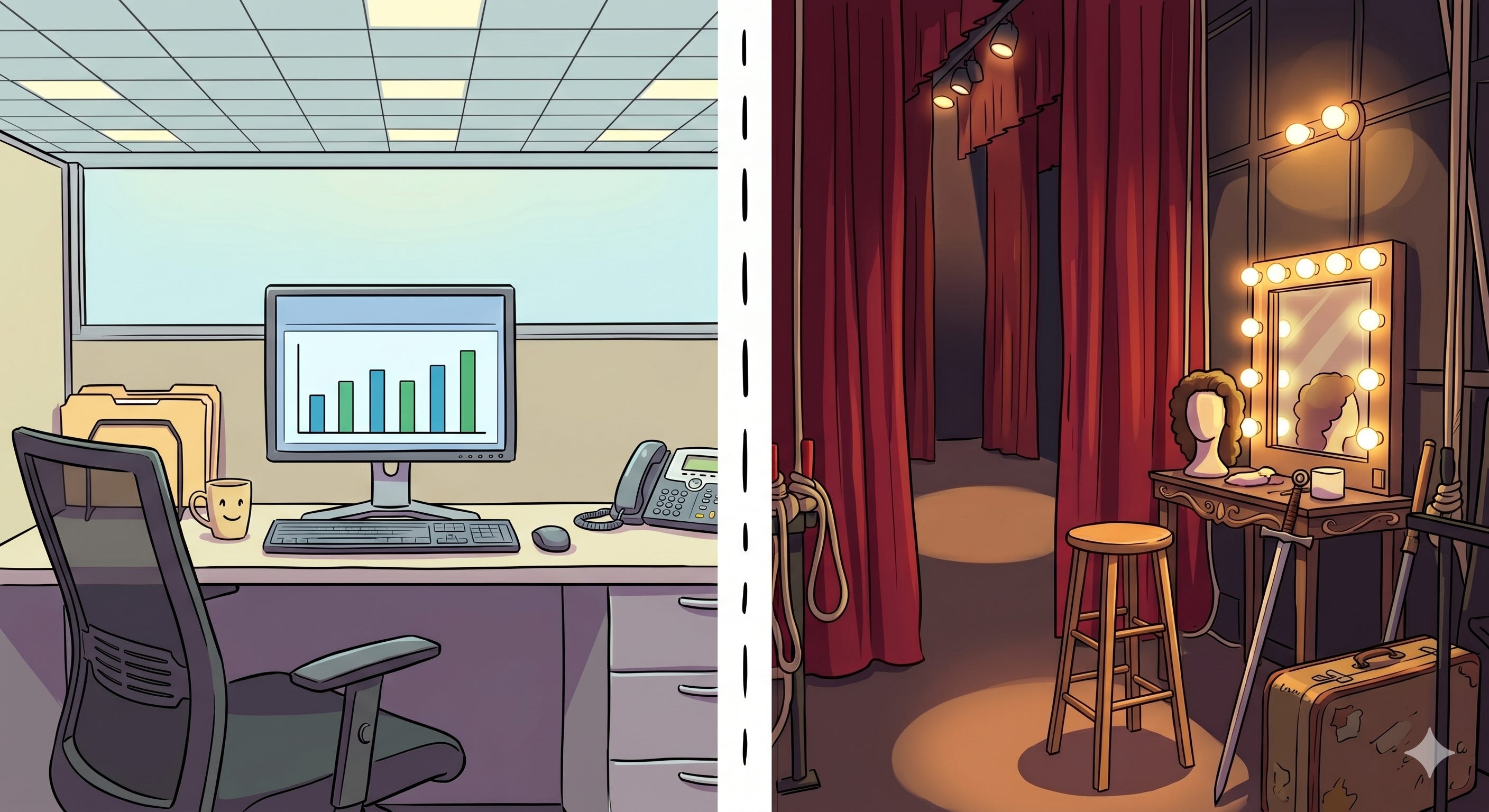
I was a theatre geek (among many other geekdoms) growing up. I loved everything about being on-stage. But I shied away from being a theatre major in college because the life seemed too unsteady. I dreaded the idea of a survival job. I wanted to know where my paycheck would come from. Most pertinently - ain’t no way my South Asian parents would’ve allowed me to be a theatre major. Any time my high school grades dipped below straight A’s, my dad would assail me with tales of having to work at a “hamburger stall” if my academics weren’t perfect.
With that pressure ringing in my ears, I chose probably the safest and most untheatrely of majors - Business. I sleepwalked through my undergrad. I survived by going to every class, kinda paying attention, and studying a couple hours/week. Oh, the pre-med majors hated us business majors. After graduation, I went into IT and have had a series of mid-level corpy jobs. They’re interesting if you squint hard enough. They’ve paid the bills. There are always so many bills. Why are there always so many bills?!
As an ‘adult’, I attended the theatre when I could. And felt jealous of (but happy for?) every single actor on those stages. It wasn’t until I was able to join a non-profit Board of Directors that I was given the most revolutionary of news - you could do theatre while holding down a corpy 9-to-5 (8-to-5, really). Duhhh. So I dove in. My first audition was for a theatre festival. I forgot my monologue midway through, went silent for 10 hours (so it felt), then recovered but they, mercifully, called time on me. I burst out laughing. I thanked the assembled directors, noting that I hadn’t done an audition in 20+ years, since high school. They laughed kindly in appreciation. I did not get a call-back.
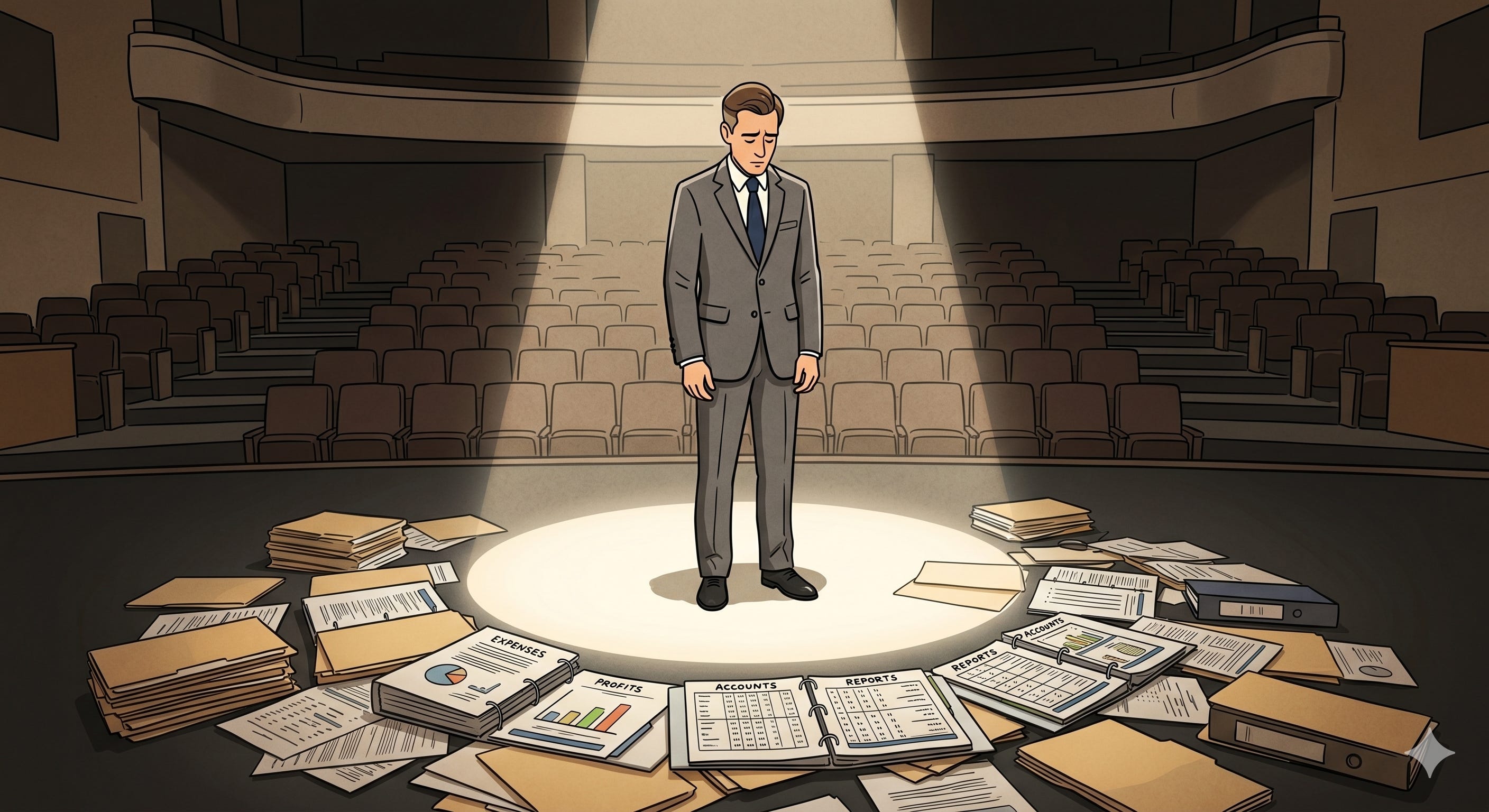
Eventually I started landing some parts. Gigs at smaller community theatres that gave breadth & depth to their locales and opportunities for people like me to get back on stage. I’ve met amazing people. I’ve met the people who I knew I could never have been, even if my parents had allowed me to be a theatre major. The ones who worked the survival jobs so they could pursue theatre as a career. Others who had found a way to make theatre their full-time gig.
It’s an amazing world.
It can also be toxic AF.
Toxic Rooms and Protected Systems
The corpy world can also be toxic AF. I’m lucky I haven’t encountered that as much in my IT career. But it’s the corporate world - some toxicity is par for the course. You steel yourself for the promise of a paycheck, some hopefully interesting work, and health insurance. Always in the back of my mind - health insurance.
I’m not sure how many people on the outside can envision the toxicity of the theatre world. They (we?) usually just think of creative people doing theatre nerdy things. But the toxicity of modern theatre is breathtaking to behold. Creatives are among the most resilient and sensitive of creatures. The work itself demands a terrifying amount of vulnerability. You try going to audition after audition, getting rejection after rejection. Smile! Move on! See if that doesn’t irk your soul after some point. Bouncing back from that time after time is tough. And simultaneously, the drive to make art, to make theatre attracts can attract and expose that deep sensitivity - those who are so open that they can inhabit a character designed by someone else.
And where that sensitivity exists, malcontents emerge. Individual predators - the nice, old director who hits on every young ingenue he comes into contact with. The actors who think that “method acting” gives them license to be assholes to everyone in pursuit of “art”. (As if being the Joker is fucking high art). I have heard so many stories of the dark side of modern theatre that it almost makes me happy to go crawling back to my safe corpy job for a paycheck. Almost.
But you cannot separate the toxic individuals from the systems that protect them. Bad behavior by headstrong creatives only flourishes when an institution looks the other way to safeguard its own reputation. And that is the real kicker - a toxic individual can (mostly) only ruin a rehearsal room or a staff room, but an institution can ruin a life.
I have been thinking a lot lately about these structures, and how ordinary (or extraordinary) people can come to place so much faith in them that they lose sight of… well, people. We expect corporations to be soulless, but we expect arts non-profits to have a heart. Yet, when the chips are down, the institutional instinct is exactly the same.
"Fie and a Pox" on Fiduciary Duty
I’ve been on the boards of directors for three non-profit arts organizations. When you’re a Board member, you are taught that your greatest responsibility is fiduciary - “a legal and ethical obligation to act solely in the best interest of the organization.”
I took the responsibility to steward those organizations seriously. But I’ll be honest - I lack skills such as strategic thinking. I know the people who have developed that skill and it is humbling to see them in their element. So what did I do as a board member? I hyped up the orgs. I pulled people in to see shows. I was a pretty good Secretary, organizing meetings, wrangling schedules, etc. and I could understand the financials but someone else always asked the probing questions.
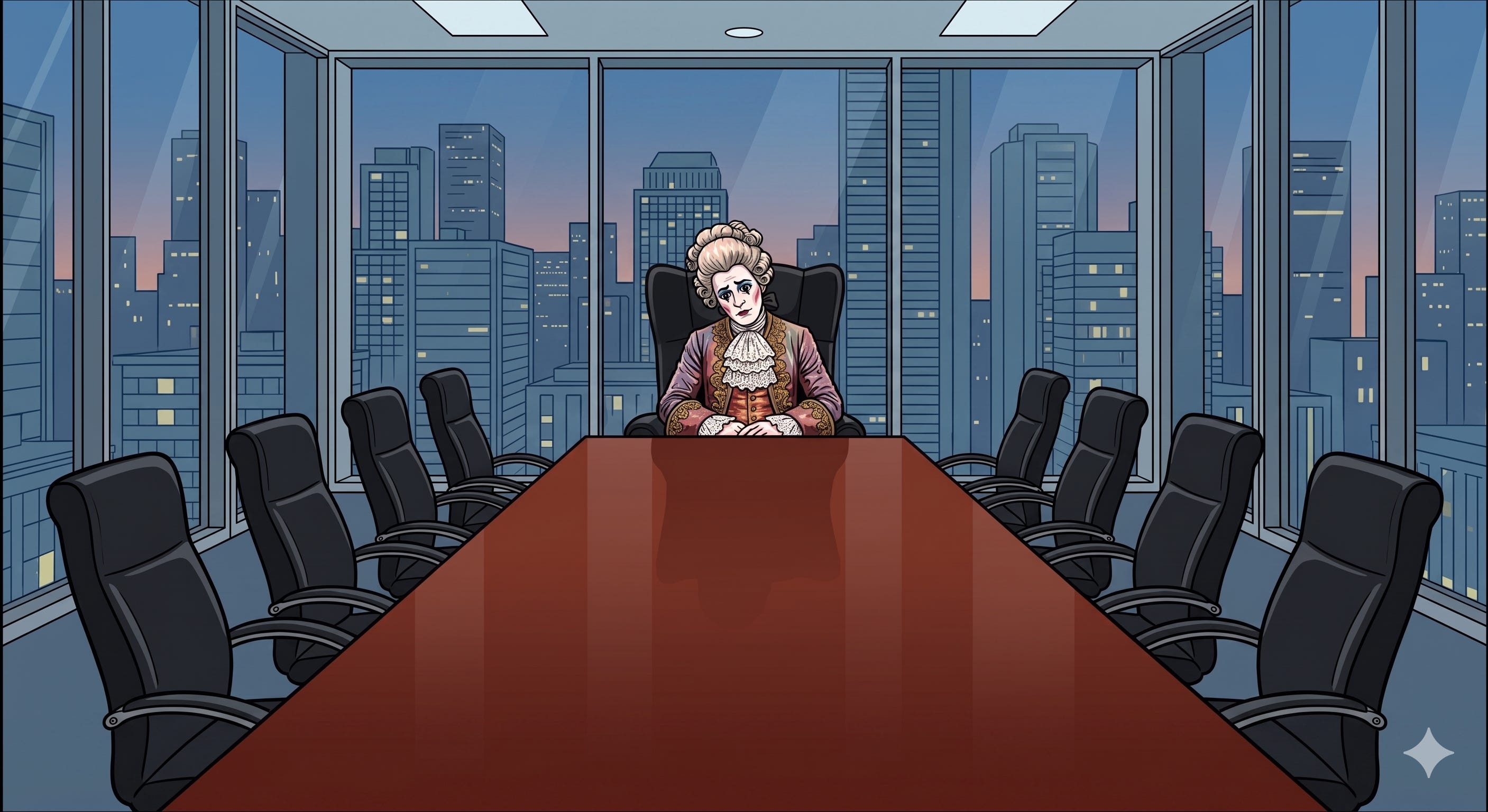
My greatest joy in being a Board Member was similar to my joy later on as an actor. People. Getting to know the people connected to the organization, whether creatively or administratively or both. Learning their stories, their lives in the Arts. And I have taken one overriding lesson that will probably get me canceled from ever being on a board ever again. (So be it).
Institutions are not more important than people. Especially in the Arts. The mission is important. Creating art that makes us laugh or cry or think is extremely difficult. Stewarding any arts institution is a difficult task. Creative and administrative differences will arise. Tensions will escalate. People’s egos will get bruised. But they don’t have to be run over. Their lives, their livelihoods don’t have to be relegated to afterthought.
It is one thing for an artist to ‘suffer’ for their own work. It is quite another to expect others to suffer for that work. To work hard, yes. But to be taken advantage of, mentally or physically. No.
The Shareholder Value of the Arts
What is it about the lure of institutions that we, as a society, have come to a place where so-called fiduciary duty seems to give people in a position of authority license to railroad their charges. This comes from both the administrative and creative side. I’ve seen or been told of both. Unfortunately, I have been party to it in a way.
I have come by my lessons hard as a board member. Too late, I tried, in my own way, to advocate for the people within the organization while simultaneously trying to fulfill my fiduciary responsibility. It didn’t work. I resigned. It still hurts that I failed the staff. It is another source of joy for me to see they’ve all landed on their feet since and, at least to my face, they don’t seem to hold a grudge. Maybe they should. I failed them, after all. I don’t hold myself higher than any member of any other troubled arts institution. I can’t.
By no means are all Arts institutions toxic. Not at all. I've worked with some great theatre companies. But the toxicity of some Arts institutions seems almost like a capitalist characteristic, even though these are non-profits. The health of the corporation over its employees. The principle of the primacy of shareholder value over employee welfare sounds an awful lot, to me, like the way some people discharge their fiduciary responsibilities.
It shouldn’t be like this. Mission, messaging, communication. Processes that protect people, that treat them with compassion and defend them and not just the institution. As I said, these are difficult things to pull off. But institutions should never be more important than people. Especially in the Arts.