
I come from a culture where faith is considered a fait accompli. Of course you will follow Islam in the same way that your elders taught you to do. For many of us raised in the West, within the Muslim diaspora, our early relationship with Allah consisted of being handed an inherited script we were expected to follow without question. We were handed a pre-packaged framework, often wrapped in the heavy, specific cultural threads of the Middle East and guarded by elders who treated doubt as non-existent, or as a taboo never to be broached. We learned the motions of Salat (prayer) and the mechanics of Sawm (fasting), but we often find ourselves waiting for a feeling of the Divine that remains elusive or illusory. We are trapped in the bondage of the trivial, where a Deen (Way of Life) is reduced to a nit-picky checklist of “is this Halal or Haram?” and the Word of God is gatekept by those who cannot (or refuse to) see that the message must speak to the language of the heart.
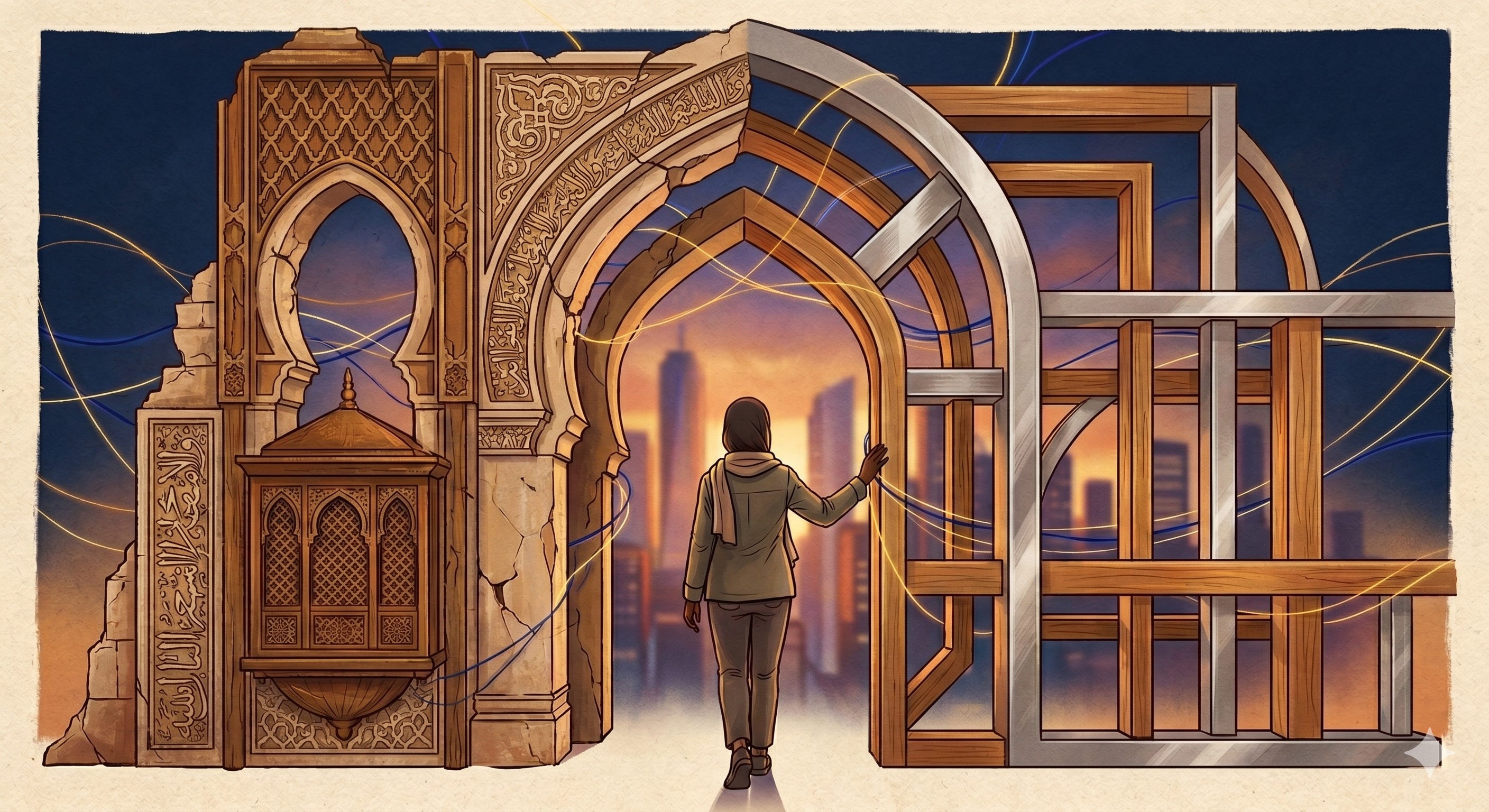
I recently finished W. Somerset Maugham’s magnum opus, Of Human Bondage, and found an interesting parallel in the journey of Philip Carey, the wanton protagonist of the story. Carey is raised in the cold, precise rectory of Blackstable by his uncle, the Vicar of Blackstable, whose religion was more a matter of social propriety than shepherding souls. His religious inheritance is a stick-frame house already hammered together. For the Vicar, the forms of the church were the primary reality, and it was just assumed that the internal presence of God would inherently flow from external rituals. Just as Carey eventually found that his rigid, inherited framework could not withstand the pressures of the wider world, many in the diaspora find that a faith built on cultural memory alone eventually collapses under the weight of secularity’s onslaught.
The Language of the Heart
For Philip, the bondage of his youth was not just the existence of a God who never answered his prayers, but the suffocating, small-minded morality of the parish. This difficulty still hits today as it translates to the steadfast refusal of some to find adaptations for religion in the modern world. When faith is reduced to checklists of permissions and prohibitions, the framework ceases to be a support system and become a series of chains. We find ourselves trapped in a structure where old-world cultural norms play too large a role, and where interpretations of the Qur’an and Sunnah are gatekept in way that feels increasingly disconnected from our lived reality. This legalistic nature acts as a barrier to the Divine; it demands that we prioritize the “forms” over the “feelings”, until the presence of God is buried under a mountain of cultural expectations.
A significant part of Islamic bondage is the refusal to decouple the message from the medium. We are conditioned to believe that in order to understand the Almighty, we must look through a specific, Middle Eastern-centric lens. This makes a kind of sense - after all, Islam originated in Arabia. But even in Arabic, the Qur’an is translated from the mind of God into the languages of Men. Everyone deserves to understand the word of God in the language they speak in their heart.1 When we ignore this, when we give greater credence to the Middle Eastern voice, we treat the Word of God as a regional framework rather than a universal truth. For the believer in the West, this creates a troubling disconnect. Some blindly accept this framing, while others rebel so fiercely that they leave the faith altogether.
The Peace-Maker’s Pattern
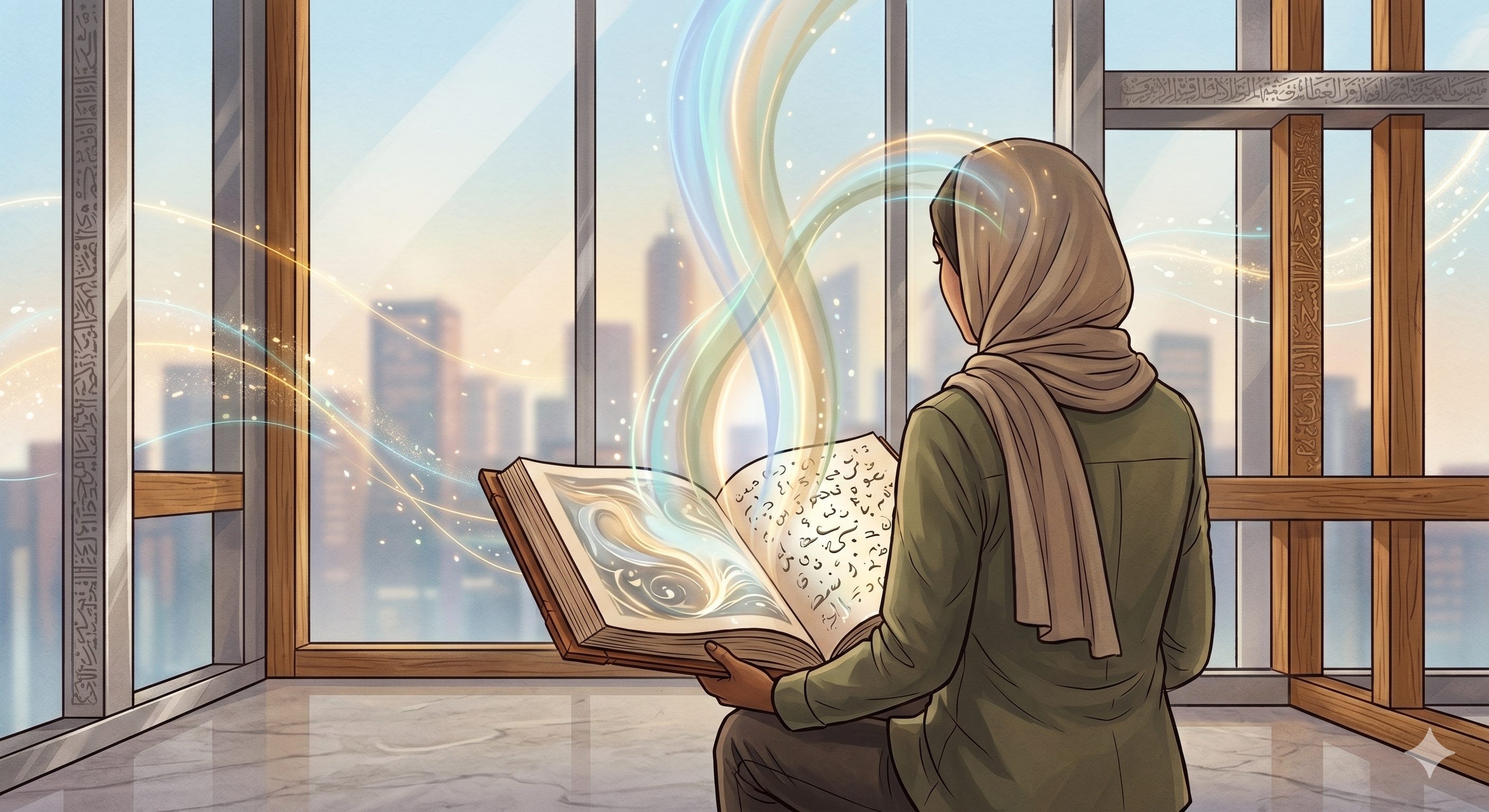
Towards the end of the the book, Carey eventually finds an interesting meaning in the example of a gifted Persian rug. He concludes that life has no inherent meaning other than the complexity of the pattern one chooses to weave. While Philip used this to justify an aesthetic atheism, those of us in the “third way” can use it to find a more authentic peace. Making peace with faith in the West requires us to become the weavers of our own internal frameworks. It means recognizing that the “mind of God” is too vast to be contained by any single cultural vessel or any rigid, 7th-century social script. It requires the courage to say that while the traditional heritage of Islam is a beautiful thread, it is not the entire loom.
I believe we must move past the “proxy faith” of our elders and the “bondage” of nit-picky legalism to build a sanctuary that makes sense in our own lives. We shall no longer pray because of a social habit or a fear of the Haram checklist. We pray because we have looked at the vacuum of the modern world and decided to fill it with a particular, chosen meaning. When we stand in the West and choose to remember Allah in the language of our heart, we are not just following an old script. We are building the framework of our own souls, weaving a pattern that justifies itself not by a tradition we were forced to carry, but by the very act of its creation. Faith is no longer a de facto fait accompli; it is a masterpiece of the will.
I think this quote originated in Orson Scott Card’s Enderverse. The author may be problematic but his ideas needn’t all be so.