
Disclaimer: if this isn't your dad or granddad or other male relative, then obviously I'm not talking about him.
It’s the oldest song in the book, and frankly, the remix is sooo tired. From YouTube vids to Tiktok to newspaper editorial pages, previous generations of men - the Silents, the Greatests, the Boomers, and even the early Gen X’ers - have made hay by criticizing the men who have come after them.
The modern, younger man is “soft.” He is “overly sensitive.” He spends too much time staring at screens and not enough time fixing carburetors or, presumably, winning world wars. The common refrain is that true masculinity has eroded, leaving behind a generation of fragile, effeminate shadows of their fathers.
But before we internalize this critique, we need to realize that this “crisis of manhood” is a historical broken record.
5,000 Years of “Back in my day…”
This isn’t a modern phenomenon; it’s an ancient tradition of insecurity. Thousands of years ago, the Sumerians and Babylonians scribbled on clay tablets about the “rotten, godless, and lazy” youth of their day.
In Ancient Greece, the critiques were more artistic but no less cringe-inducing. Plato was clear in The Republic, grumbling that in a declining society, the “young man is just as good as his elder” and that fathers begin to fear their sons because they lack “proper” restraint. Even the Roman poet Horace complained in 20 BC that “our fathers, viler than our grandfathers, have begotten us who are even more unrighteous.”
For five millennia, the “hard” men of the past have looked at their sons and seen a decline. Yet, civilization is still here. The only thing that has actually “declined” is the specific brand of rigidity each generation mistakes for strength.
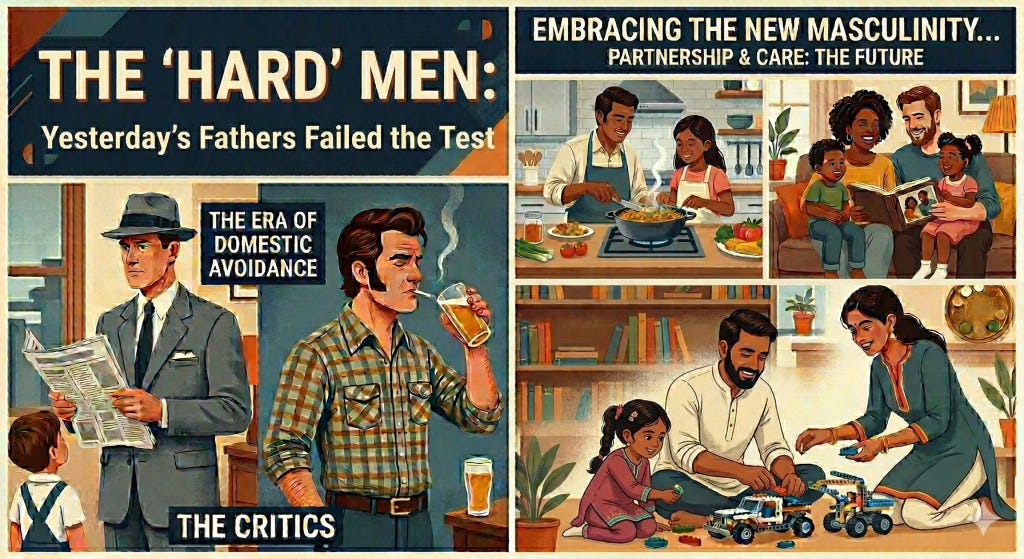
The Comfort of the Domain Clash
The defining dynamic of previous generations of men was their dogged commitment to domestic ineptitude. The script was simple: Men worked in the public sphere (the domain of “important things”), and women managed the private sphere (the domain of cooking, cleaning, child-rearing, and emotional support).
This was a profoundly comfortable arrangement for men. They could claim “leadership” while simultaneously abdicating responsibilities.
The Greatest Generation and the early Boomers were not “equal partners.” To be an equal partner means that when the work outside ends, the work inside begins together. It is to recognize that the work of the private sphere was indeed work of its own, worthy of as much respect as work of the public sphere.
Instead, for these critics, “fatherhood” was often defined by its absence. A father was a distant provider, a disciplinarian, an authority figure who emerged from behind the newspaper only to settle disputes.
When these men critique younger men for valuing “work-life balance,” they aren’t critiquing a lack of ambition. They are critiquing a refusal to inherit their negligence. They are criticizing the fact that younger men look at their corporate bosses and say, “I won’t let your deadlines erase my presence in my daughter’s life.”
Even when the motivation was not overtly chauvanistic, adhering to a traditional definition of masculinity is inherently brittle. Allow me a story about my father. Now, I loved my father and I will always miss that he never had an opportunity to know his fourth grandchild. He did the best he could, which is all that we can reasonably ask. But my mom once told a story wherein she asked my father to get a bottle of milk ready for one of us. He responded that he didn’t know how to do that.
Understand that this was a man of the highest intellect; a man who could argue anyone to almost any conclusion in his day. He wasn’t even a stranger to the kitchen either. My father was the one who first took me through cooking a chicken curry (with deshi aromatics & spices, with some split peas and potatoes). Yet he froze at (or fobbed off) the idea of simply pouring milk into a saucepan and warming it up over the stove, then pouring it into a bottle. And I don’t think he ever changed a dirty diaper.
The Fragility of the Alpha-Male Protector Performance
The critique of modern “weak” masculinity heavily relies on the image of the “physically dominant protector.” In this myth, traditional masculinity is about muscle, grit, and defending the citadel against an external enemy.
While physical courage is admirable, it is also episodic. True strength - resilient strength - is enduring. And nothing reveals the fragility of traditional masculinity like being asked to nurture a sick child, soothe a grieving teenager, or honestly navigate a complex emotional conflict with a spouse.
Many of the old guard didn’t engage in these tasks because they deemed them “women’s work,” but perhaps the deeper reason was that they were too difficult. They lacked the emotional stamina, the patience, and the vulnerability required for genuine connection. It is far easier to win a corporate negotiation than it is to de-escalate a toddler’s meltdown or honestly tell your partner, “I am afraid.”
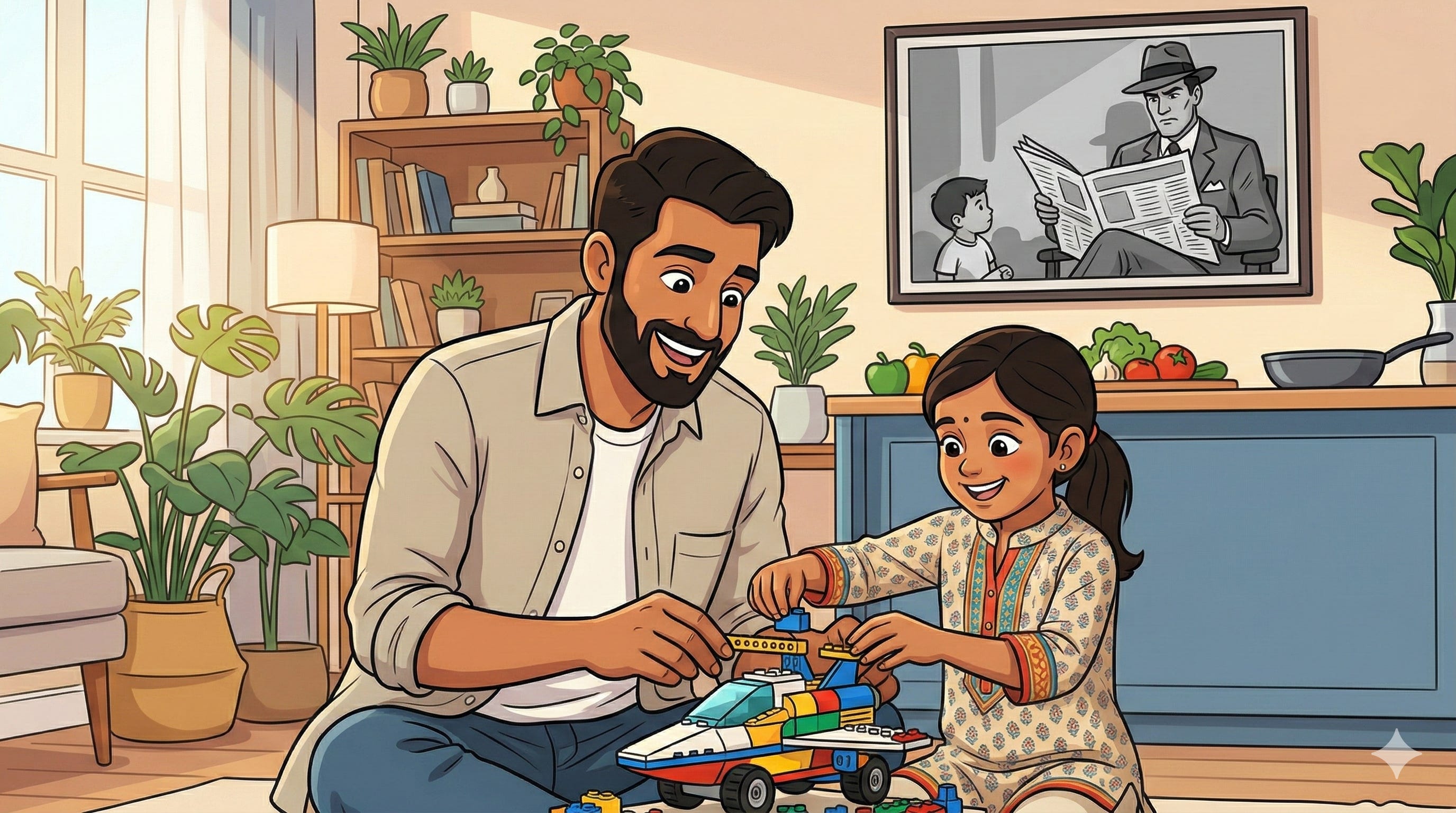
This is where the hypocrisy becomes deafening. The generation that claims younger men are “sensitive” and “weak” is the same generation that was absolutely terrorized by their own feelings, viewing any emotional display other than anger as a threat to their masculine performance. True toughness isn’t suppressing your emotions; it is mastering them so you can be a rock for your family, not a roadblock.
A Softer, But Far More Resilient, Strength
Thus, the thesis of modern fatherhood: The definition of true masculinity must expand. We reject the zero-sum game that claims care is incompatible with strength.
The standard of manhood should not be: Can you throw a punch? The standard should be: Are you a safe, nurturing harbor for the people you claim to love?
True masculinity is nurturing: It is realizing that bathing your child, making dinner, and managing household cleaning are not tasks you “help” with; they are the shared bedrock of a functioning family and a loving partnership. (Wifey, if you're reading this, I swear I'm doing my best!;)
True masculinity is sensitive: It is possessing the emotional intelligence to sense tension, validate feelings, and connect with your spouse and children at a deep, human level.
True masculinity is building: It is using your ambition not just to amass personal status, but to actively construct a life that is softer, more connected, and more sustainable than the one you inherited. It is choosing presence over prestige.
The next time an elder looks down their nose and makes a comment about the “softness” of modern men, remember the image at the top of the post. On the left - remember the sterile, unapproachable “leadership” that past generations of men. Then look at the image on the right - at the messy, complex, collaborative, and joyful reality of modern, involved fatherhood.
The critics of yesterday aren’t criticizing weakness. They are witnessing the birth of a masculinity that is far stronger and far more resilient than they ever dared to be. We aren’t going backward; we are building a foundation that will actually hold.