
We like to think that history is written in stone, but the truth is that it is written in pencil, and pop culture carries a comically large eraser.
Imagine being a king. Imagine being a man so powerful that your name is synonymous with the word “mighty” for three thousand years. Then, imagine losing it all to a rabbit who was just trying to land a joke about a guy in a deerstalker hat. This is the story of Nimrod - the king who became a punchline - and how a cartoon rabbit successfully committed the greatest identity theft in history.
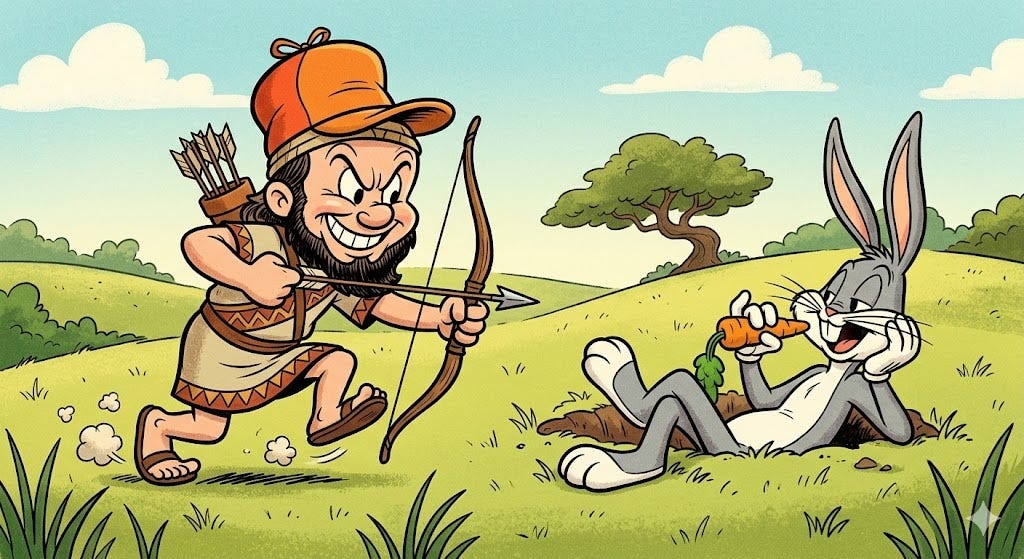
The Original Titan
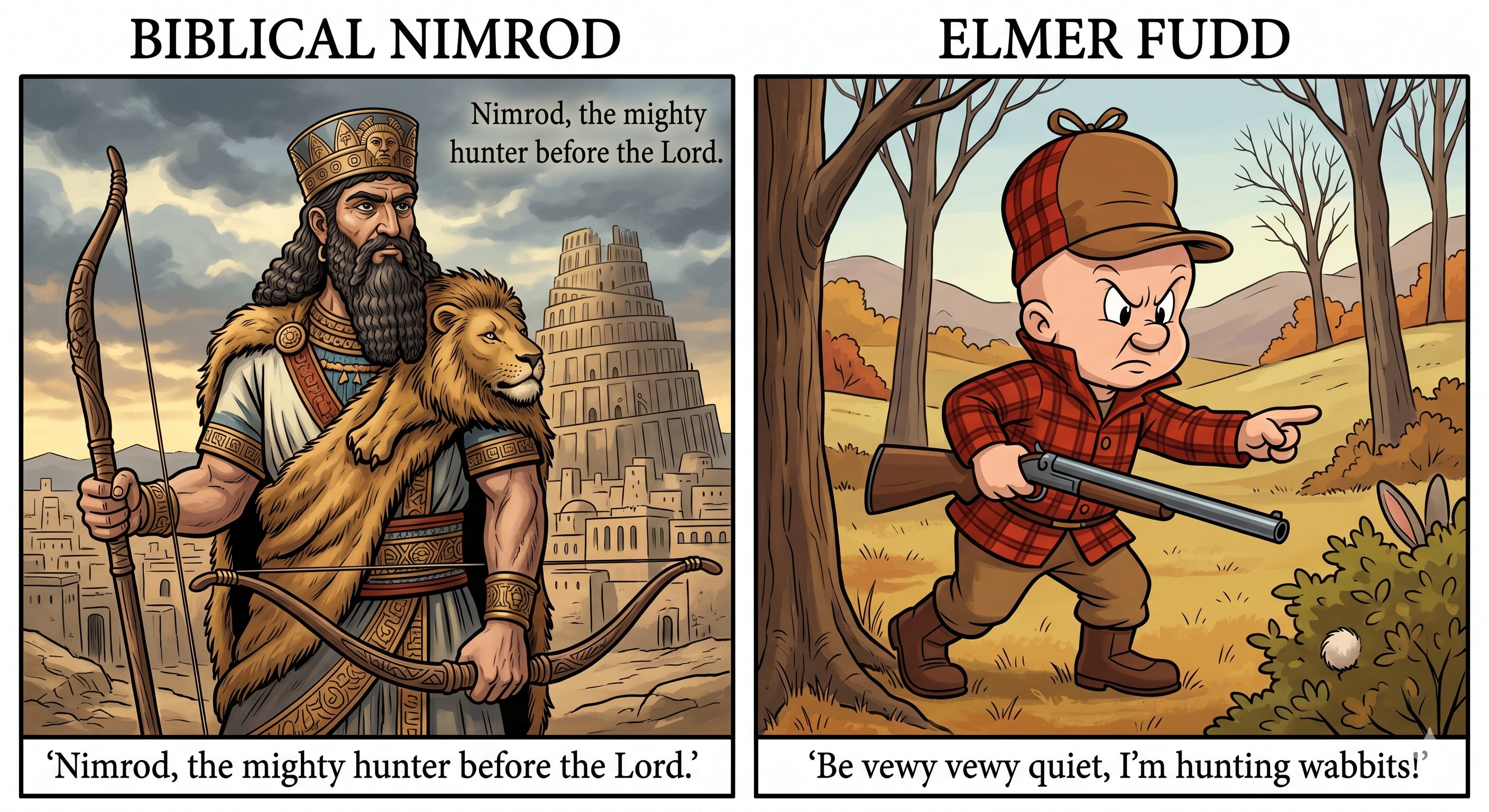
In the world of the Old Testament, specifically Genesis 10, there is a man named Nimrod. He was the son of Cush, the great-grandson of Noah, and a figure of monumental prowess. The Bible describes him as “a mighty hunter before the Lord.” For millennia, if you called someone a Nimrod, you were comparing them to a titan - a king who built empires in Shinar and Assyria.
Fast forward to these United States of Amurrica. If you call someone a “nimrod,” you are calling them a moron. You are saying they are a “knucklehead,” or a “dolt.”
How did one of the history’s great alpha’s become history’s biggest loser? The answer involves a sarcastic rabbit and the sheer, overwhelming power of Saturday morning cartoons.
The Bugs Bunny “Irony Gap”
The linguistic pivot happened in the mid-20th century, courtesy of Looney Tunes. Bugs Bunny, a character defined by his wit and meta-commentary, frequently referred to his antagonist, Elmer Fudd, as a “nimrod.”
Bugs was being ironic. He was mocking Fudd’s total incompetence as a hunter by comparing him to the greatest hunter in the history of civilization. It was a high-level joke - the 1950s equivalent of calling a slow runner “Usain Bolt.”
The problem? The audience was mostly children. These kids understood the context - Bugs was making fun of Elmer - but they didn’t know the source material. They didn’t see the irony; they saw a brand-new label for a dummy. Within a single generation, the “mighty hunter” was erased, replaced by the image of a bumbling man with a double-barrel shotgun.
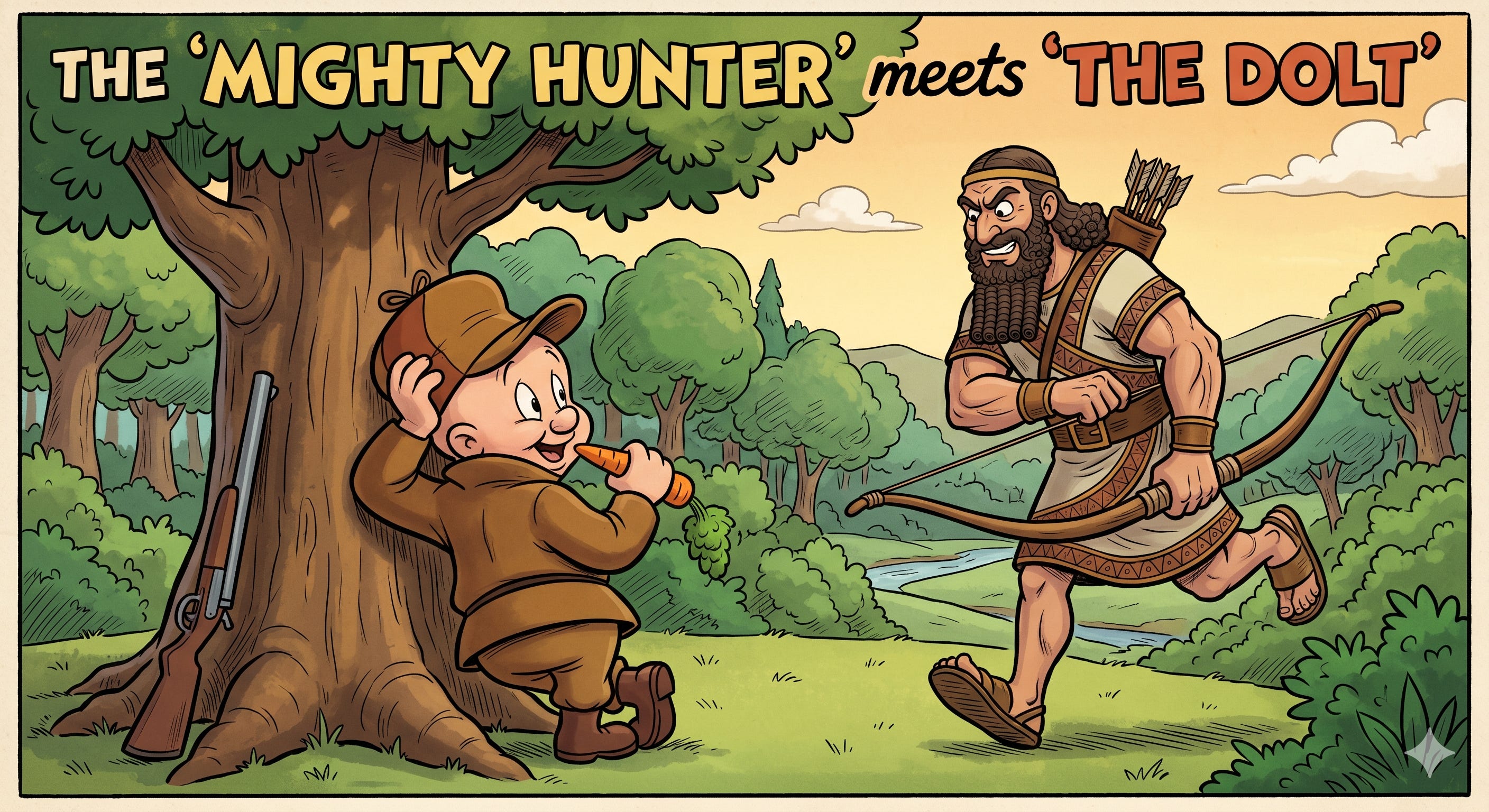
Growing up, I also loved Looney Tunes, as most kids do. In the eternal battles of Bugs Bunny vs Elmer Fudd, the great Rabbit calling his nemesis a “nimrod” wasn’t anything to view askew. I knew that nimrod mean eediot. And being Muslim, I would never have read about the original Nimrod. But later on, in the 90’s X-Men cartoons, I was introduced to a time-travelling robot hunter named Nimrod. “Why would the X-Men cartoons name a character a moron?” I thought. Clearly this Nimrod was a feared hunter. Will the real Nimrod please stand up?
The Powerless Pew
There is a fascinating irony here. Mid-century America is often portrayed as a time when the Bible was the undisputed foundation of the home. But even the most well-meaning, Bible-reading parents were effectively powerless against the “Nimrod Effect.”1
Imagine a father in 1955 trying to correct his son: “Actually, Jimmy, Nimrod was a mighty king in Genesis.” It wouldn’t have mattered. Once a word becomes a playground insult, its etymology is irrelevant. In the battle between a 3,000-year-old genealogical table and a wisecracking rabbit, the rabbit wins every time.
It shows that pop culture acts as a more efficient catechism than formal education. It uses humor and repetition to overwrite tradition in a way that “study” simply can’t match. Even if you knew your Bible cover-to-cover, you couldn’t stop the rest of the country from turning your “mighty hunter” into a punchline. The Looney Tunes were simply too big to fail.
The New Catechism
Today, the rebrand is complete. Most people are “nimrods” in the Bugs Bunny sense - confident in their language but totally disconnected from its origins. It serves as a reminder that a culture’s “source material” is always in competition with its entertainment.
The king of Shinar was powerful, but he was no match for a rabbit with a carrot and a sharp tongue. In the end, the Bible provided the name, but Bugs Bunny provided the connotation. And in the American lexicon, connotation is usually decided by whoever makes us laugh the loudest.
While we all remember Bugs Bunny saying it to Elmer Fudd, it was actually Daffy Duck who first weaponized the word in 1948. hah! In a final twist of irony, we even managed to misattribute the cartoon character who started the trend. Bugs did eventually use the word nimrod… on Yosemite Sam! Behold, the Mandela Effect before Mandela.
🐰 you’re a looney tune 🤣🤭😎