
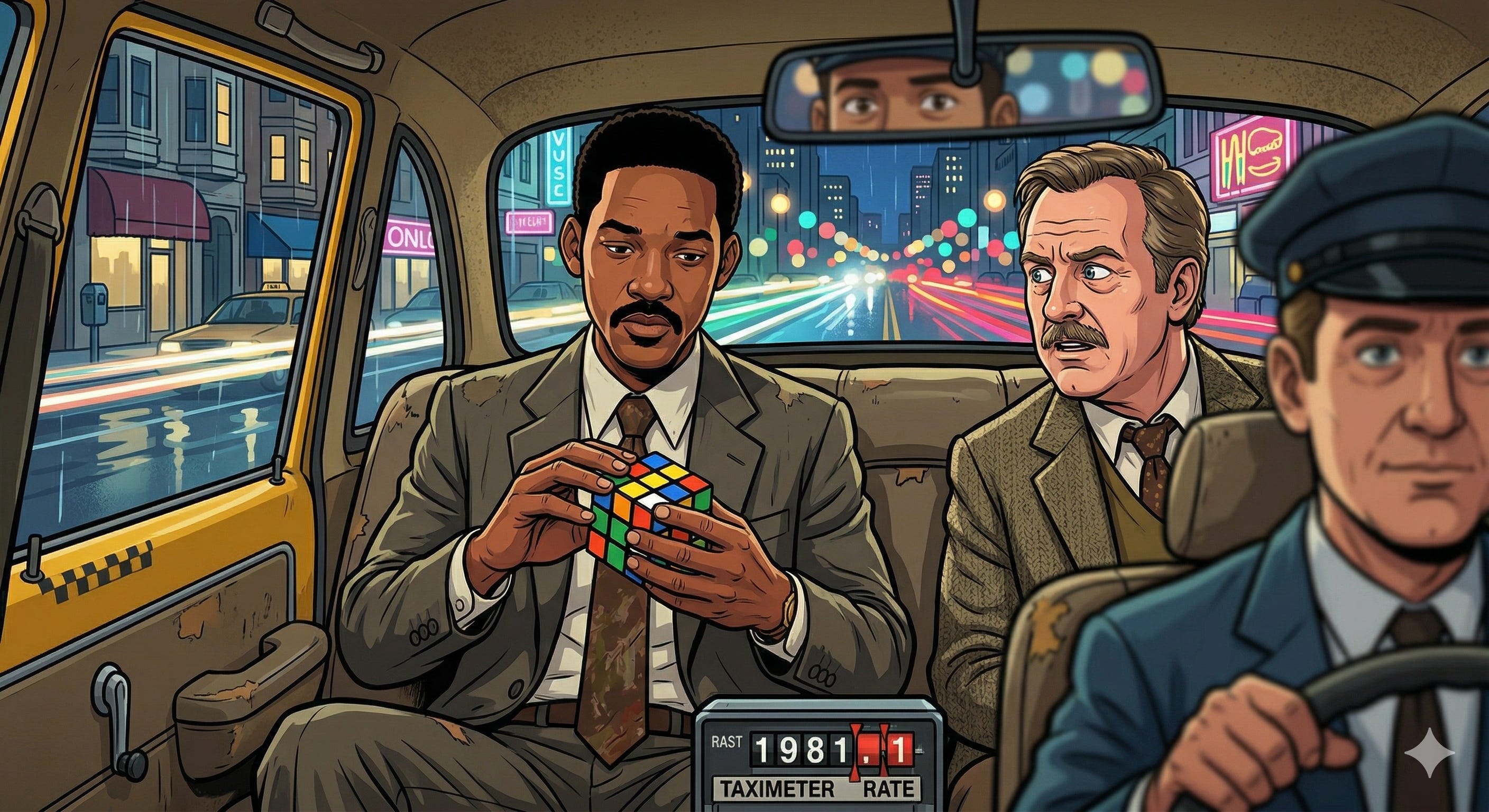
In the 2006 movie, The Pursuit of Happyness, there is a scene that has become a classic of inspirational Hollywood. Chris Gardner, played by Will Smith, sits in a taxi with a high-level brokerage manager named Jay Twistle. Twistle is fumbling with a new craze - the Rubik’s Cube. He is visibly frustrated, calling the puzzle “impossible” and a “waste of time”.
Gardner claims he can solve it. As the taxi weaves through San Francisco’s streets, the camera cuts between Gardner’s intense focus and the click-clacking of the plastic blocks. Just as they reach their destination, Gardner finishes the cube! All the colors are perfectly aligned. Twistle is flabbergasted. In that moment, Gardner is no longer solely a struggling salesman; he is a candidate with immense potential. The “magic” hath happenedeth.
It is a great cinematic moment. It is also a lie.
The Myth of the “Natural”
The lie is the idea that solving a Rubik’s Cube is a tell for natural-born genius. In the movie, the cube serves as a visual shorthand to tell moviegoers that Gardner is a prodigy. We are supposed to believe that because he is “naturally” smart enough to solve a 43-quintillion combination puzzle on his first try, that genius will translate to success in the high-stakes world of high finance.
This narrative is comforting because it turns success into destiny. Hollywood loves the “Natural” because the natural is dramatic. It is far more exciting to watch a man solve a 43-quintillion combination puzzle (worth stating the number twice in one article, I think!) in a three-minute taxicab ride that it is to watch him sit at a kitchen table for eight hours/day reading manuals and textbooks. But this framing is a trap. By portraying proficiency as a “gift” that some people just have, we ignore the reality of Craft.
When we treat intelligence as a mysterious, innate, cosmic force, we fundamentally misunderstand that Excellence is achieved through hard work, through the Grind. We trade the reality of that Grind for the fantasy of the breakthrough.
Excellence is a Choice
In the real world, the Rubik’s cube is not solved through flashes of genius. (How many combinations does it have again?). It is solved through algorithms.
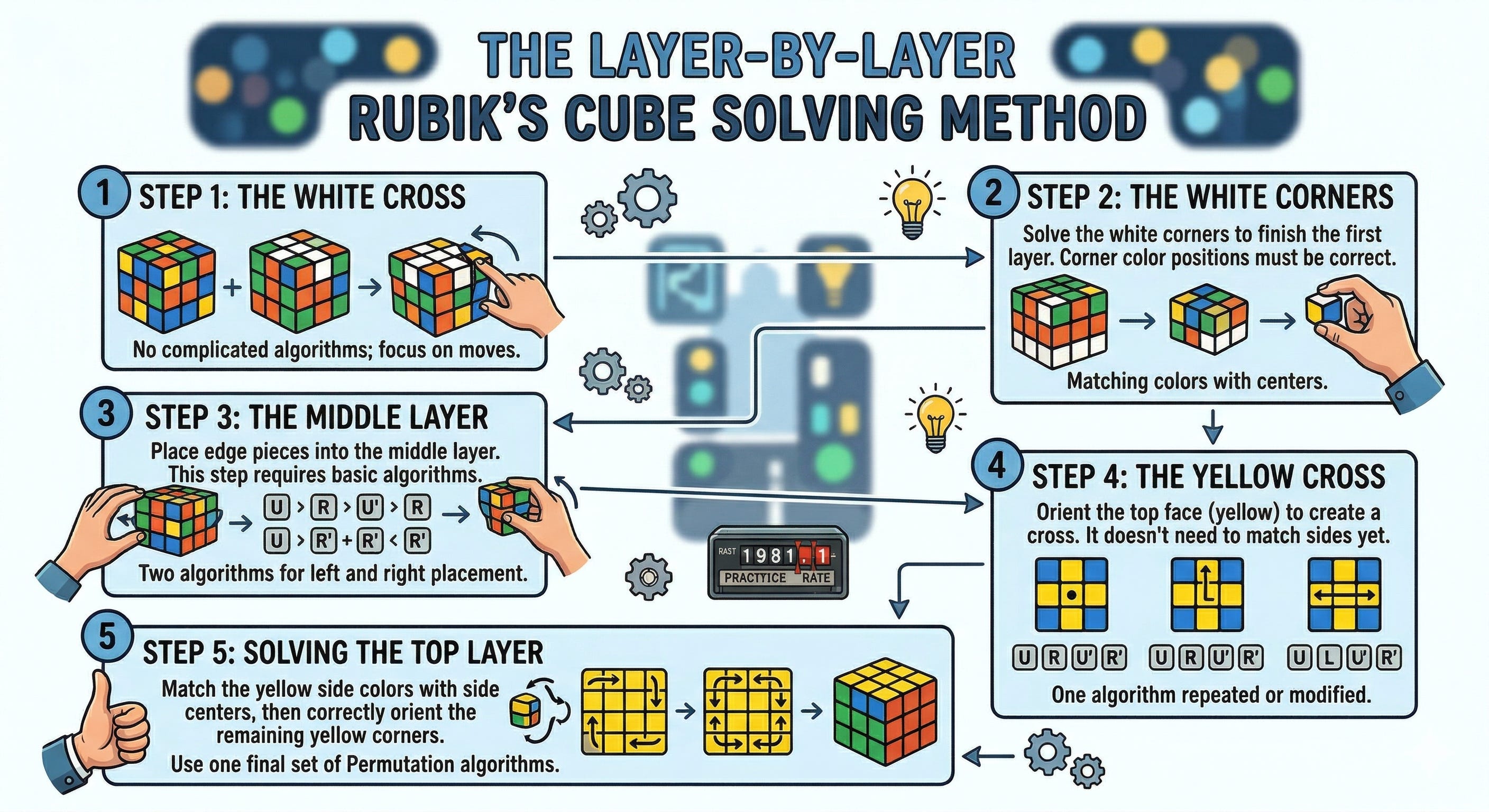
To solve the cube, you do not need a high IQ; you just need the patience and fortitude to memorize a series of systems. It is the process of learning specific sequences of moves that manipulate certain pieces without messing up the rest of the puzzle. Whether it is the Layer-by-Layer method used by beginners such as myself or the Cross method used by the more seasoned, it is a mechanical skill. Anyone with average intellectual ability and a browser pointing to ruwix.com can learn to solve the cube in a few hours of focused effort.
The achievement is not marked by being smart. The achievement is having the discipline to sit with the initial chaos and trust the system until it resolves into order. Proficiency is a choice to endure confusion until the patterns become clear. It is a microcosm of professional (or even athletic) skill: you learn the rules, you train the movements, and you repeat over and over and over until they become second nature. And over.
I didn’t grow up going to garbas and playing dandiya Raas. The first time I heard of Raas was in college. After I found myself as part of Pitt’s Raas Chaos team my senior year of college (most likely because I just showed up to auditions), I would literally sit on my bed in my apt and manual move the dandiya through my fingers until I could twirl it without thinking. This was especially critical for my right-hand since I’m a lefty. I was never the strongest on my team, but being part of Pitt’s 2nd-place finish at the Raas Chaos competition at GWU in November 2002 is still a fond memory.

The Copout of the “Genius” Label
But why do people lap up the “Genius” narrative if it is actually inaccurate. Because it protects our ego.
If we believe that solving the cube (or becoming a successful stockbroker, or twirling a dandiya at a competition) requires a “special” persona, then we have a built-in excuse for not doing those things ourselves. We can look at someone else’s success and say, “Well, shucks, I just ain’t Chris Gardner (or Will Smith), so there’s no way I could do what he did.”
The “Genius” myth is a copout. It allows us to avoid the Grind. If success is actually just about doing the boring work - learning the algorithms of a new industry or making extra phone calls or practicing a skill until it become muscle memory - then we are responsible for our own lack of achievement or proficiency. If greatness is a gift, we are let off the hook. But if greatness is a Craft, then our lack of it is a reflection of our own lack of effort.
Systems vs Sparks
The Cube Lie extends beyond the movie theatre. We see it in how we discuss techmology, leadership, even parenting. We look for the “spark” of innovation instead of the “system” of execution.
In the corpy world, for example, we look for the “rockstar” who can solve a crisis with a brilliant insight. But the most successful initiatives are usually the result of people who have honed their skills in communication, risk management, and iterative progress over years and years of project work.
When we value the spark over the system, we create a culture that waits for heroes instead of training practitioners. We wait for the taxicab ride where we can show off, rather than noticing the quiet hours where we actually learn the moves.
The Pursuing of Pursuits
According to the Googles, the real Chris Gardner did not solve a Rubik’s Cube to get his chance at the bigtime. He got his chance because he out-worked everyone else in the room. In his memoir, he describes a life that was far less about magic and far more about the Grind. He made more calls, stayed later, and studied harder than the interns who had the luxury of stables home and Ivy League degrees.
The move title uses the word Pursuit, which implies a chase, a struggle, a sustained effort over time. But by inserting a magic moment like the Rubik’s Cube solve, the film briefly stops being about pursuit and becomes a “chosen one” story. It suggests that Gardner was always destined for success because of his natural ability.
I think the real story is much more impressive and inspirational - a man who was not a natural at Finance but became a Master through relentless effort. He learned the algorithms of the market the same way anyone learns the Rubik’s Cube - one layer at a time.
Solving Your Own Cube
Most pursuits in life, like the Rubik’s Cube, require far more hard work than natural talent to achieve excellence. We look at the jumbled cubes in our lives, our careers, our personal goals, our relationships… and we wait for a moment of “inspiration” to strike. Like lightning.
But life doesn’t work like 1980’s taxicab montages. There are no shortcuts that bypass the need for repetition and study. Life is about finding the right algorithms, practicing the moves, and having the discipline and intestinal fortitude to keep twisting the layers until the chaos resolves into order and success.
If you want to solve the cube, stop looking for the magic moment. Start learning the moves. The pursuit is about being willing to work until you find happyness.
I love this theme so much! I just watched a substack live with Priya Patel that reframed skills as ‘crafts’ and how many years we spent learning those crafts, sometimes without knowing how they’ll help us. And it’s true we love the genius story bc it absolves us in some part. But it’s also so satisfying to watch excellence unfold in unexpected ways (the underdog story). But to your point, here’s to working it.