
There is a specific kind of silence that follows the click of a mouse. It isn’t the heavy, responsible silence of a house finally asleep two floors up. It is a thinner, sharper silence. It’s the sound of a door closing that you didn’t think you’d ever have to shut.
I recently unfollowed someone on Instagram. (oooooooohh!!)

It wasn’t a dramatic exit. There were no grand speeches, no burning of bridges in real time. Just my finger hovering over a button, a moment of hesitation, and then the digital severance. They had been posting sporadically for a while, but every time they did, it was a fresh volley of anti-Muslim content. Memes disguised as “questions.” Vids stripped of context but heavy with implication. The kind of rhetoric that doesn’t just disagree with policy but seems to take joy in the dehumanization of people who look like me, pray like me, and share my name.
The Banality of the Heel Turn
What made it jarring wasn’t simply the content; it was the source. This person isn’t a stranger. We worked together years ago. They are intelligent, well-traveled, and have spent significant time in the Middle East, India, and Southeast Asia. They’ve seen the richness of the religions and cultures they now seem to resent. They aren’t someone I would have pegged as easily recruited by the MAGA-adjacent, bigoted machinery that churns out this stuff by the gigabyte.
And yet, there it was. A slow, steady heel turn into Islamophobia.
I’ve been thinking about the “why” of it. In my post about The Phantom Menace, I wrote about how the most nefarious ends are often hidden behind boring headlines - how monsters hide in trade ledgers rather than marching in dramatic, sweeping black capes. Maybe the same is true for micro-radicalization. Maybe it doesn’t start with a burning cross or a hate crime. Perhaps it starts with a quiet grievance, a sense of economic or cultural displacement, and an algorithm that feeds you just enough outrage to keep you clicking until you wake up five years later hating people you once worked alongside.
I’m Exhausted of this Script
I thought about reaching out. I drafted a message in my head a dozen times. ”Hey, I’ve seen your posts lately. Is everything okay? This doesn’t seem like you.”
But then I played out the inevitable script. Their defensiveness: “No, I’m not a bigot. I’m just asking questions! Why is everyone so sensitive?” And then my own reactionary defensiveness rising to meet it: “Don’t you see what you’re espousing? Don’t you see how this hurts actual people?”
It would be a tennis match of talking past each other, a draining exchange where the only winner is the algorithm that keeps us both engaged. I realized I didn’t have the energy for it. Work, Family… I don’t have the bandwidth to be a one-man de-radicalization committee for someone I haven’t spoken to in years.
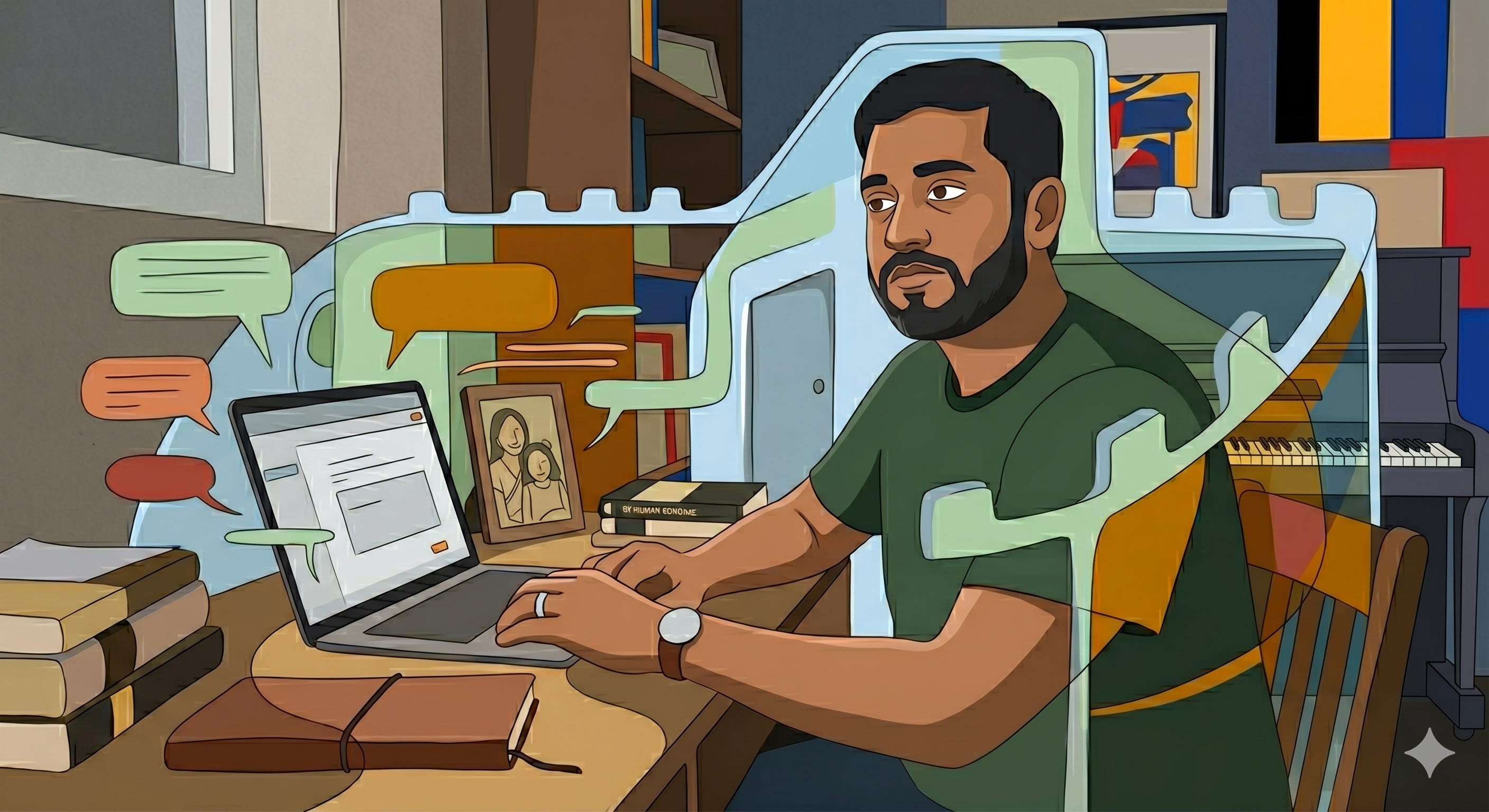
So I clicked.
This makes two people I’ve cut off in the past six months. It’s not a habit I wear proudly. I’ve always prided myself on being the guy who keeps the door open, the one who believes in “Adda” (sprawling conversations) and welcoming the stranger. I believe in the friction of differing views. I think my daughter needs to see a world where people can disagree without disappearing.
The Micro-Grief of the Digital Age
But there is a line where “differing views” curdles into something that denies my humanity. Even after that line is well crossed, the grief of cutting someone off is still real. It’s a sadness that feels disproportionate to the medium. After all, it’s just Instagram or Facebook. It’s just pixels. But these were people I knew in real life. They were good people, or at least, I thought they were. To see them reshaped by a political machine into something unrecognizable feels like a specific kind of loss - a death of the person they used to be, even if they are still physically here.
One of the most admired, progressive people in my extended circle once admitted to me that their views weren’t always so progressive or admirable. They grew up in a conservative religious environment with little exposure to people of different faiths or sexualities. When they got to college, they met different people and there were those who patiently helped them see the light, so to speak. I imagine it was a process, not a sudden awakening.
I sometimes think about the people who took the time to talk it out with that friend. I feel a lot of gratitude that they did. What if they hadn’t? What if they had written them off? Was it frustrating to make the same arguments, the same points to a new person? And then, presumably, another and another and another. Did they see the seed of some curiosity, some openness in that friend that they didn’t see in others whom they didn’t waste their energy on? And, to give due kudos, how admirable was it of that friend to listen and begin to change their old views.
As I looked at my former colleague's profile, I searched for that same spark - the small seed of curiosity that makes the labor of dialogue worth the cost. I found only the cold certainty of dogma.
A Fortress of Differing Ideas?
We talk a lot about polarization in the USA as a macro problem. We argue about election results, Supreme Court rulings, and the state of democracy. But we don’t talk enough about the micro-griefs. The quiet funerals we hold in our pockets when we realize that a cousin, a former colleague, or an old friend has walked into a fog we can’t follow them into.
In Bengali culture, the mantra of “Lok ki bolbe” (“What will people think?”) hangs heavy over almost everything. It’s a mechanism of social control, a way to keep the circle tight. But there’s another side to it: a deep, cultural aversion to cutting ties. Family is family. Friends are friends. You endure. You tolerate. It’s hard but there can be wisdom in that discomfort.
But tolerance has a cost. And sometimes, the cost is your own peace.
I don’t think unfollowing these people will change the world. They probably won’t even notice. But for me, it was an act of boundary-setting. It was a declaration that the Fortress I’m building for my daughter has walls, and those walls exist to keep out the things that would poison her spirit before she’s old enough to understand them.
It’s a messy, imperfect solution. I’m not sure how much I’m protecting myself versus just hiding. Maybe it’s both. But as I sit here in the quiet of my basement, listening to the hum of the dryer and the distant sound of traffic, I feel a strange mix of relief and sorrow. Relief that the noise has stopped. Sorrow that it had to come to this.
Not everyone we once knew is capable of finding their way back to the light. Some might. Some might not. And in this case, I’m okay with not being the one to drag them there.
For now, the silence is enough.