
Every Fourth of July, the noise of default patriotism (bordering on jingoism) gets rather loud. The air fills with charcoal smoke, the exciting bang of fireworks, and a massive, sometimes tacky AF wave of red, white & blue branding. We are told that this is the day to feel proud of where we live. Amrika! Fuck yeah.
If you step away from the spectacle of ID4, a much more interesting question pops up - Who actually earns the right to be proud of our country?
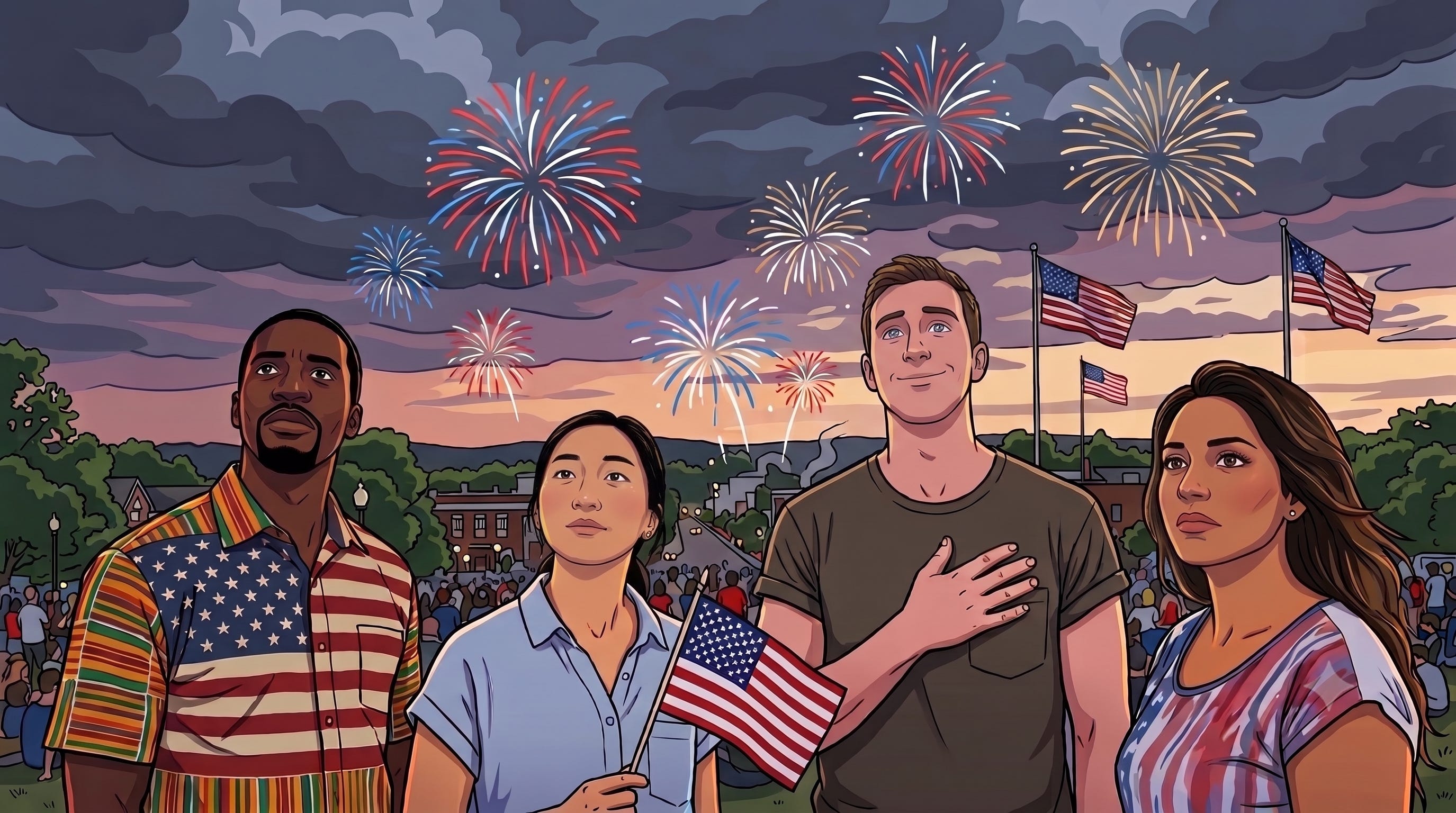
If this nation is supposed to be built on a civic contract - an agreement around ideas like justice and opportunity rather than a shared bloodline or an ancestral ethnicity - then pride cannot be the default setting. A civic nation is a messy, ongoing project, not a static inheritance. If civic pride belongs to anyone in this country, it belongs foremost to the immigrant and Black folks.1
Choice, Inertia or Coercion
To understand how civic pride is actually earned, you have to look at how people came to be part of the civic contract in the first place. There are three entirely different paths.
For some whose families have been here for generations, citizenship is basically an accident of geography. They inhabit this space out of sheer momentum, created by someone else. Their presence here requires no active sacrifice, no uprooting of their world. They are citizens by inertia.
On the other end is the voluntary immigrant or refugee. For them, citizenship is an act of pure will. To leave behind a homeland - to pack up one’s life and walk away from language, culture, religious networks - is a scary gamble. They look at the abstract ideals written in the founding documents and decide they are worth risking everything for. They are the ones who actively sign the contract.
But there is an foundational caveat to this binary. There is a huge segment of this country whose ancestors never chose to come here.
The Architects of the Civic Contract
Black folks, whose ancestors were brought here in chains, occupy a rather unique position in this story. They did not sign up for this country; they were forced to come here and yet they built its foundations - culturally, musically, spiritually, physically, culinarily - while being explicitly and often legally excluded from its promises.
And so, their claim to civic pride, to the degree they may choose to do so, does not come from the voluntary choice of immigration. It comes from a brutal, centuries-long history of sacrifice and relentless struggle.
The rights that modern immigrants and default citizens take for granted today did not just appear on their own. They were bought and paid for by the blood, sweat and tears of Black Americans who fought to force this nation to live up to its own lofty rhetoric. From Abolition to Reconstruction, from the Civil Rights movement to the fight for LGBTQ+ rights, every major expansion of American liberty was dragged into existence by Black folks fighting for their own rights - and in doing so, opening the door for every (non-white) immigrant who has followed.
They did not inherit a functioning house, and they did not choose to move into one. They built the house under duress and then spent generations fighting to make it fit for human habitation.
The Landlord Mentality
This completely reframes how the rest of us should look at stewardship. A civic nation is not a piece of family property that we outright own; it is a complex piece of shared infrastructure. And the rent is paid daily through civic duty.
However, when pride separates from duty, it devolves into hollow nationalism or jingoism - a vanity that loves a flag or a border but remains indifferent to the actual people living there. The passive citizen treats the nation like a service provider, ready to complain to the manager when things break dahn.
But an active citizen knows that democratic institutions and community spaces cannot run on autopilot. They require constant, unglamorous maintenance. If you are a (non-black) citizen by default, your only path to legit pride is to join in doing the heavy lifting to keep the system functioning and building towards equity.
Reclaiming the Fourth
The immigrant & Black American experiences are the greatest barometers of our collective civic health. They force the multi-generational default citizen to look at their own backyard sans rose-colored glasses. They are called to ask: Are we actually maintaining a society worthy of the sacrifices people made to get here, and the sacrifices people made to fix it?
When you look closely, the answer is an uncomfortable truth. We see systemic failures, widening inequality, and institutions groaning under the weight of neglect.
But to point out these flaws is where civic pride and civic critique become the same thing. If you care about the foundational ideals of the American experiment, you are obligated to point out where the reality falls short of the promise.
Please go out and have fun this Fourth of July. But look past the performative vanity of the holiday; that’s not a measure of this country’s health. A truer measure would be to examine how faithfully we honor the contract that some risked everything to sign, and others sacrificed everything to hone.
I’m honestly still wrestling with how the peoples of the First Nations fit into this specific critique. They didn't arrive by inertia, choice, or forced labor to build a new system - they had established, functioning societies that were systematically decimated and stolen by settlers. They were lied to, exploited, and forced into a contract designed to erase them. Their relationship to this country isn't about earning a place in the civic project; it is about sovereign survival against it.
Love this thoughtful critique and breakdown of what patriotism actually means. So much nuance and analysis. Also would love to see your footnote about native Americans incorporated into the text or a future post! They are the original Americans 250 years ago, this day we are “celebrating” today.