
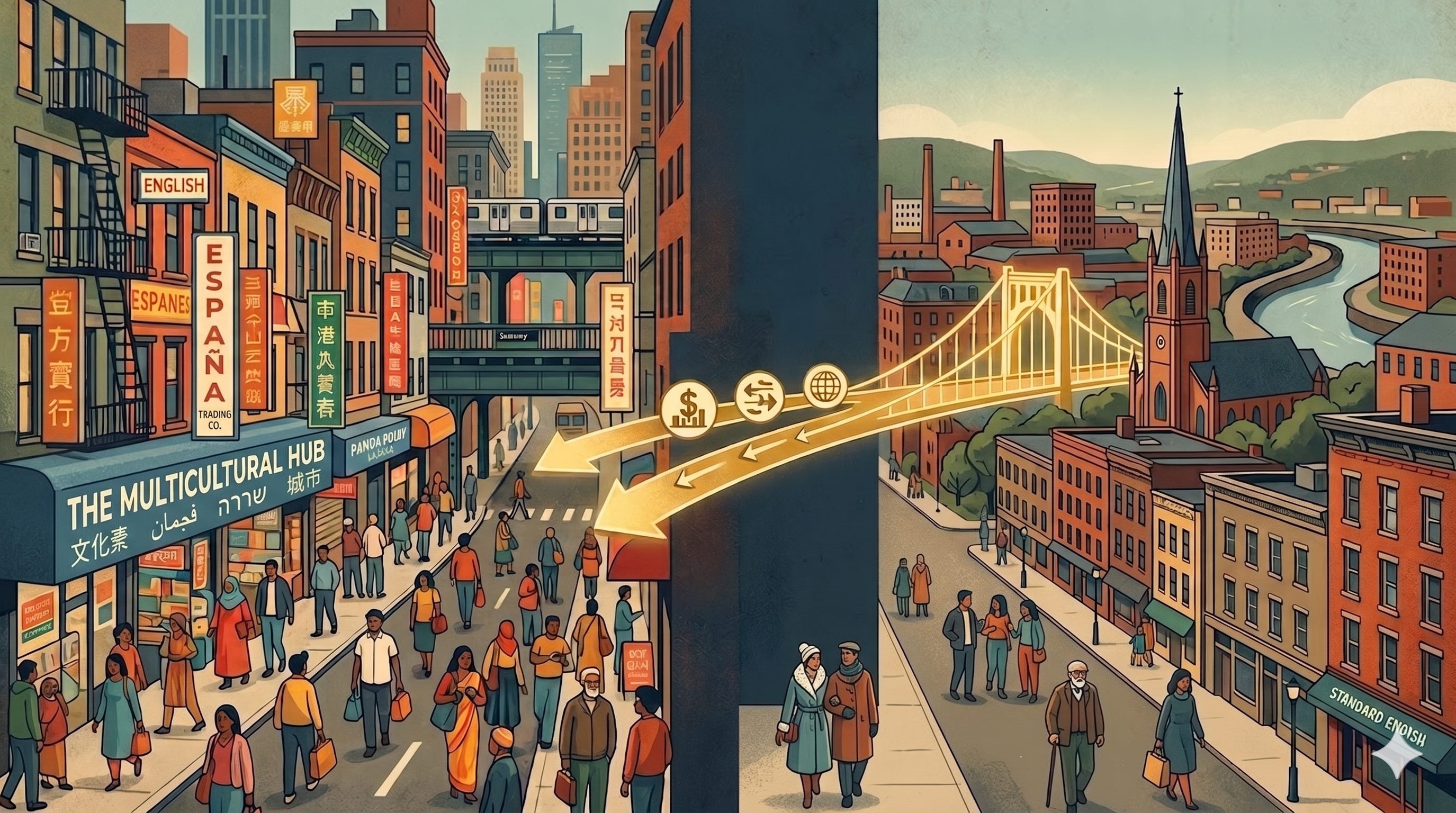
I’ve been thinking lately about diversity. We have some in Pittsburgh, but nothing to compete with a place like New York City. Duh. I see more Latinos around the area than I did growing up. Chi-Chi’s isn’t the Mexican restaurant of record anymore. We have Venezuelan, Colombian, and Oaxacan restaurants to name a few; just a few. We have some Szechuan restaurants that compete for the James Beard Award. I’ll admit to being a little defensive when the comparison is with NYC in particular. I love my birth city but fuhgeddaboudit. It feels aspirational to look to a great city like NYC or Toronto but it’s also slightly unfair.1
Spend enough time in a hyper-diverse megalopolis like NYC, especially if your skin doesn’t fear the sun, and your baseline perception of what the world can offer shifts. Journey through Queens, and you’re surrounded by hundreds of languages, cuisines, and a dizzying array of backgrounds. It feels vital. It feels electric. My oldest sister once described Dhaka, Bangladesh as “desperately alive” but I think it’s a sobriquet that also applies to Queens, esp. in these affordability crisis days. If you’re a PoC or just someone who has grown to love that tapestry, such an environment almost becomes a necessity. You crave it. When you leave the bubble that is NYC and travel elsewhere, you immediately notice its absence and you bemoan the lack of it.
It’s a completely understandable response. A friend of mine recently sent me some pics of a Pride event in Pittsburgh. Her caption, “jeez, invite some Black & Brown ppl!” She hated seemingly being the only Brown person there. I don’t really disagree with her disappointment.
Diversity isn’t an abstract buzzword or something valuable for its own sake. It is an operational and cultural good. It expands minds and shatters echo chambers. It is valuable in almost every configuration - diversity of culture, religion, race, gender, sexual orientation, etc.
But, and here is where I come by my defensiveness honestly, when we demand that every city, every institution, every regional center instantly mirror the hyper-pluralism of a global hub, we run into a wall: true diversity is rare. Everywhere on this godforsaken third rock from the sun, it is exceptionally rare. In our eagerness to champion pluralism as an imperative, we sometimes fail to recognize the economic and historical machinery required to produce and sustain it.
The Anomaly of the Mega-Megalopolis
New York City, London, even Singapore where my mind often drifts, aren’t the natural baseline for human civilization. They are hyper-concentrated global crossroads that have spent centuries sitting at the intersection points of international empire, maritime trade, and capital flows.
Hoomans, left to their own devices, cluster around shared geography, language and kinship. Homogeneity is the baseline state for the vast majority of cities and towns around the globe. I once met a New Yorker in Istanbul who bemoaned the lack of good lox & cream cheese in Türkiye. What?! True pluralism doesn’t happen because a population spontaneously decides to be enlightened. It is generated by yuuuge structural engines, requiring vast transit systems, housing density, globalized labor markets and diaspora networks that can support new arrivals. There are around 140,000 Guyanese folk in NYC. When my wife’s family emigrated from Guyana in the 1980’s, NYC was really the the best (and only) choice for them.
Grading a mid-sized legacy city or a regional center on the same demographic curve as a global financial center confuses a macroeconomic phenomenon for a localized moral failing.
Consider my home, Pittsburgh, or any number of mid-sized post-industrial regional cities across the interior of the USA. These places do not look like NYC or Toronto. They possess their own distinct (often European-based) immigrant histories tied to industrial expansion in the 1800’s. But in today’s market, they lack the modern economic magnets that pull tens of thousands of international arrivals every single year (as opposed to hundreds). They are not failing a moral test; they are just operating within their own economic and geographic realities.
The Unforgiving Messiness of Human Movement
When you stop treating the creation of diverse spaces like a corporate mission statement or a municipal checklist, you begin to see it for what it actually is: an exercise in the utter messiness of human existence.
Even the most carefully planned of urban models can’t dictate where people move to. They move because a factory closed, or because an uncle had a basement apartment in Queens, or because a war broke out acrosst an ocean. Too often, they uproot their entire worlds out of a sense of raw desperation, ambition, and necessity.
And so the communities formed from that necessity are often fragmented and uneven. In Pittsburgh, our pockets of diversity show up in fits & starts - an influx of international students around Oakland or Squirrel Hill, Nepalese grocery stores and restaurants in the South Hills, or the Hindu temples located in and around Monroeville, east of the city. These ventures, these communities are small, vulnerable, and exist at the odd, unpredictable whims of local life.
Human settlement is a stubborn thing. It is defined by language barriers, economic struggles, and the quiet, sometimes lonely task of building a life in a place that does not have a pre-existing safety net waiting for you. When a smaller city lacks a certain demographic percentage, it is usually just a snapshot of how slow, uneven and complicated it is for people to thread themselves into a new landscape.
Cherishing the Chaos
BUT! though I deign to moralize, I would not give up so easily on the goal of creating diverse spaces. I’m just not going to offer policy prescriptions.
I only want to highlight that when we rec’nize the extreme rarity of hyper-diversity, it changes how we value it. It stops being a measuring stick that we use to beat up on smaller communities for failing to achieve the nigh impossible. Instead it allows us to look at the mega-diverse hubs of the world with a sense of wonder at how they function at all.
The hyper-diverse cities of the world are not flawless paradigms of harmony. They are loud, friction-filled, often too expensive, and constantly teetering on the edge of structural collapse. That they manage to keep the chaos just organized enough to function without collapsing into warring tribalism is a remarkable achievement.
We should praise them, study them, and nurture & protect them. But we should also be clear-eyed about the geographic and economic forces that govern where people live. By honoring the mechanics of human movement, we can champion the good of diversity while respecting the beautiful, oft-frustrating messiness of the world in which it operates.
Caveat: While we share many commonalities, I only feel qualified to opine on the trials of immigrant and non-Black communities of color. The tribulations of Black Americans, as it relates to fostering diversity & inclusive spaces, are whole ‘nother kettle of fish.