
I recently finished the Earthsea series by Ursula K. Leguin. The first 3 books - A Wizard of Earthsea, The Tombs of Atuan, and The Farthest Shore - in the series are considered classics of the fantasy genre - wizards/mages, dragons, evil, etc. Le Guin explores the profound responsibility that comes with individual power and the necessity of maintaining "The Balance" within the world. Throughout the original trilogy, the concept of agency manifests as a loud, visible force. It is the power to summon dragons, to knit together the broken ring of Erreth-Akbe, and to cross the dry land of the dead.
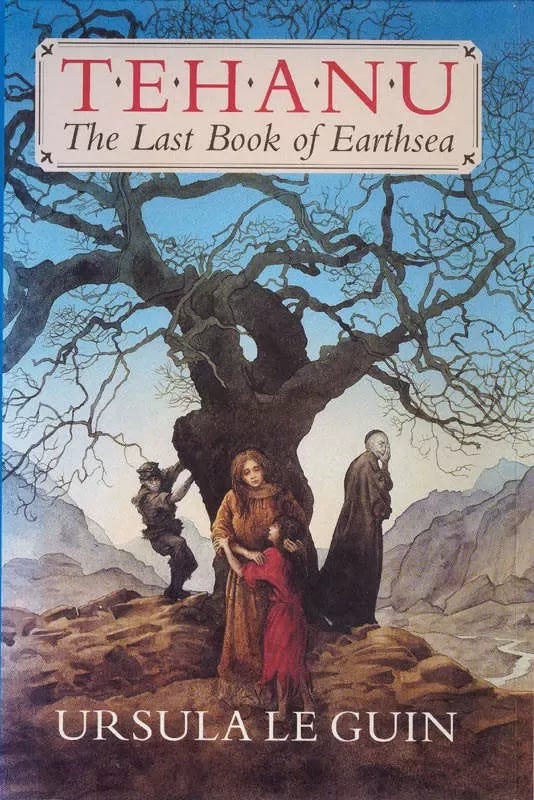
It is in the fourth book, Tehanu, written 16 years after The Farthest Shore, where Le Guin shifts the definition of agency from the “high” power of the wizard (mage) to the “deep” power of the home and hearth. This is not a story of conquest, but an exercise in how a woman and a child build a fortress from the ruins of trauma and societal neglect. (It is one of the few books I would give a 10/10).
The Domestic as a Bastion: Choosing the Fortress
For the central character, Tenar, agency is initially defined by her rejection of the “High Deeds” of men. Having escaped the suffocating, soul-crushing silence of the her role as High Priestess of the Tombs of Atuan, she does not seek the glitz and glamor of Havnor, the capital of the archipelago; nor does she choose to study the seductive powers of magic. Instead, she chooses dirt, goats, and the hard life of a farm woman on the island of Gont. To the wizards of Earthsea, this looks like a retreat, a women shrinking when faced by the prospect of “greatness”. To Tenar, it is a radical act meant to fortify her own agency and expand her world past the world of the mages.
The framework of Tenar’s healing is built on the repetitive, grounding acts of domestic life. In a world where men use “Naming” to control nature, Tenar uses “Doing” to inhabit it. There is an immense and satisfying agency in the making of bread, the mending of wool, and the tending of a garden. These are the acts that sustain life while the wizards are busy debating the metaphysics of it. By choosing the role of a farm woman, Tenar asserts that her life belongs to her alone, independent of the great myths and tidings of Earthsea.
Therru: Agency from the Ashes
If Tenar’s agency is about her choice to walk away from magic, the character of Therru’s agency existing in mere survival and the simple act of taking up space. Therru is a child who has been literally and figuratively discarded - thrown into a fire by those who should have protected her. She enters the story as the personification of pure trauma, a “burnt child” who exists on the absolute margins of a patriarchal society that views her as broken and unmendable.
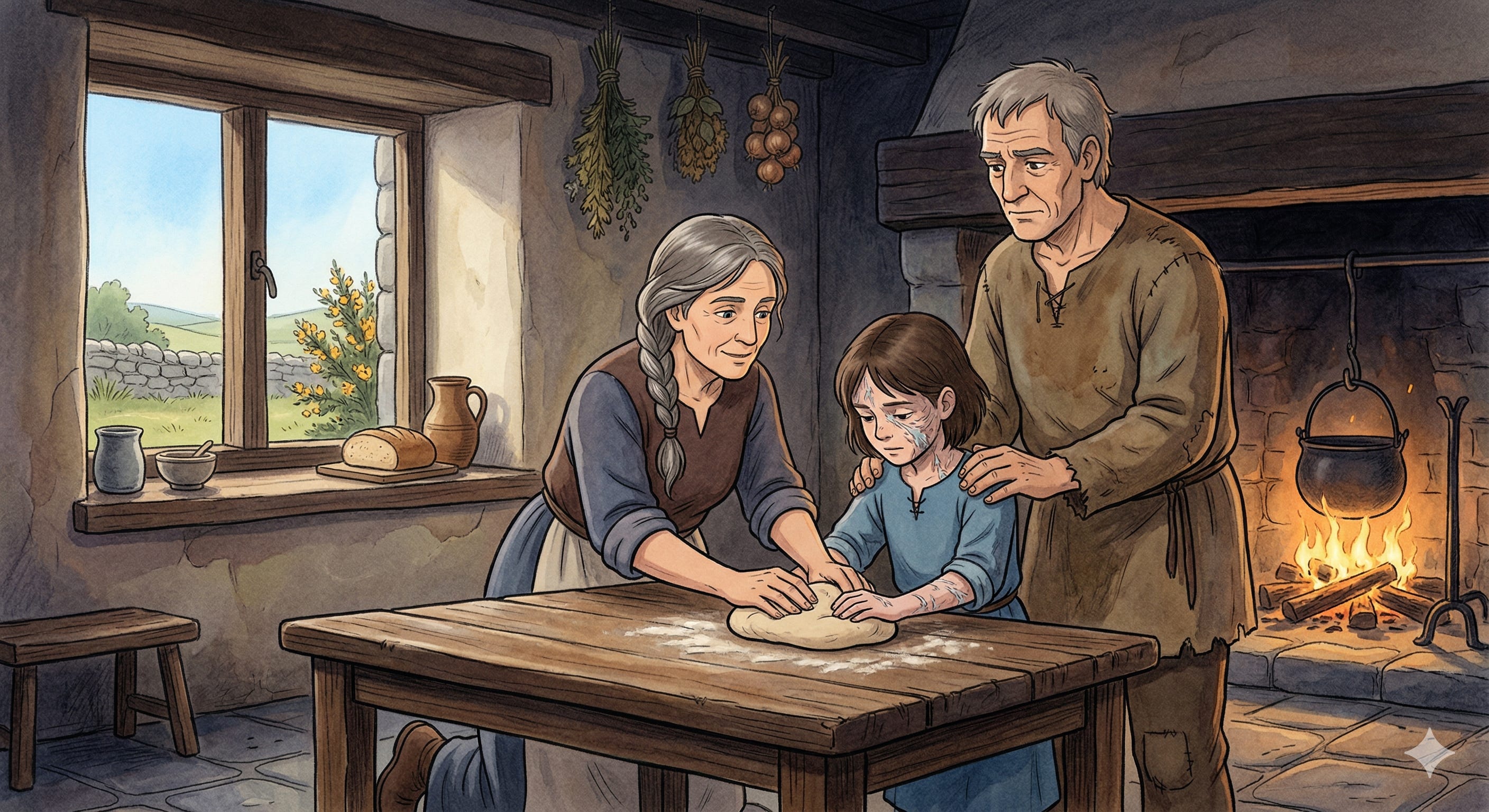
The framework of Therru’s healing is slow and agonizing. Her agency does not come from a magical restoration of her sight or her skin; Le Guin deliberately refuses to “fix” her with a spell. However, every time she chooses to speak (however seldom) in her raspy broken voice, to walk into the village, or to trust Tenar, she is rebuilding her shattered life.
Her silence is not a lack of power, but a protective cocoon. When she eventually speaks her True name - Tehanu - it is not a gift granted by a mage like Ged, she finds her power by connecting her suffering to the “Old Powers of the Earth,” proving that the victim’s voice can carry more weight than the Archmage’s staff.
The Collapse of the Heroic Pedestal
The arrival of Ged - broken, powerless, and stripped of his Archmage status - serves as the ultimate test for the two women’s frameworks of healing. In the old Earthsea, Ged was the center of the world’s agency. In Tehanu, for much of the book, he barely wants to go on, sleepwalking through his life, prodded by events and finally by Tenar.
Ged’s struggle is that of a man who must find himself, his agency, without the awe-inspiring power and authority he once commanded. He has spent his life as a “Doer” of great things; now, he must learn the agency of “Being”, of “Existing” simply for the sake of existing. He must learn to be a man who chops wood, who cares for a child, and who accepts the protection of a woman.
The framework for Ged’s healing also rests in his newfound (and long overdue) relationship with Tenar, a partnership based on vulnerability rather than hierarchy. By stripping Ged of his magic, Le Guin forces him to build a new self-image that is not dependent on being “the best” or “the only.” His agency is reclaimed only when he stops trying to be a hero and starts trying to be a human.
The Confrontation with False Power
The villain of the book, the wizard Aspen, represents the antithesis of this healing framework. Aspen has all the traditional powers of a mage: he has spells, he has status, and he has the “authority” of Roke, the island where wizards are trained. Yet, his power is entirely parasitic and misogynistic. He uses his magic to diminish Tenar, to mock her “ordinariness,” and to attempt to strip her of her speech.
The conflict between Tenar and Aspen is a battle between two different types of agency. Aspen’s agency comes from the will to dominate life - to bind and break. Tenar’s agency is the ability to remain whole despite the binding. When Aspen tries to curse her, he fails not because Tenar has a stronger spell, but because he fundamentally cannot understand that a soul that may not place value in that which he himself values. He cannot name her because she has already named herself through her work and her love for Therru.
The Old Powers and the Dragon
The climax of the book, involving the dragon Kalessin, serves as the final stone in these frameworks of healing. The dragon does not come to save a damsel-in-distress or to reward a HERO®. It comes because of the kinship between the child and the dragon - a bridge between the human and the ancient, primal world.
In this moment, the agency of the (so-called) meek is vindicated. The wizards of Roke are left behind, staring at the sky, while the woman and child engage in a conversation with the oldest force in the world. The healing is complete when the framework of the hearth is expanded to include the entire sky.
Conclusion: The Strength of the Hearth
Ultimately, Tehanu argues that true agency is found in the places the world deems “unimportant” and “mundane”. It is found in the endurance of the survivor, the labor of the caretaker, and the silence of the broken. Le Guin reminds us that while the old world may eventually perish in the fires of industry, the hearth, tended by those with the courage to heal slowly and fitfully, is the true center of the world.
Agency is not just the power to change the world; it is the power to remain yourself within it. For Tenar and Tehanu, that is the most difficult, and most beautiful, framework of all.
Recommended Reading
The ‘Hard’ Men: Why Yesterday’s Fathers Failed the Masculinity Test

Disclaimer: if this isn't your dad or granddad or other male relative, then obviously I'm not talking about him.
The photo is interesting 🧐