
Some stories don't offer comfort - they offer clarity. They show us the helplessness we already feel and tell us we're not wrong for feeling it.
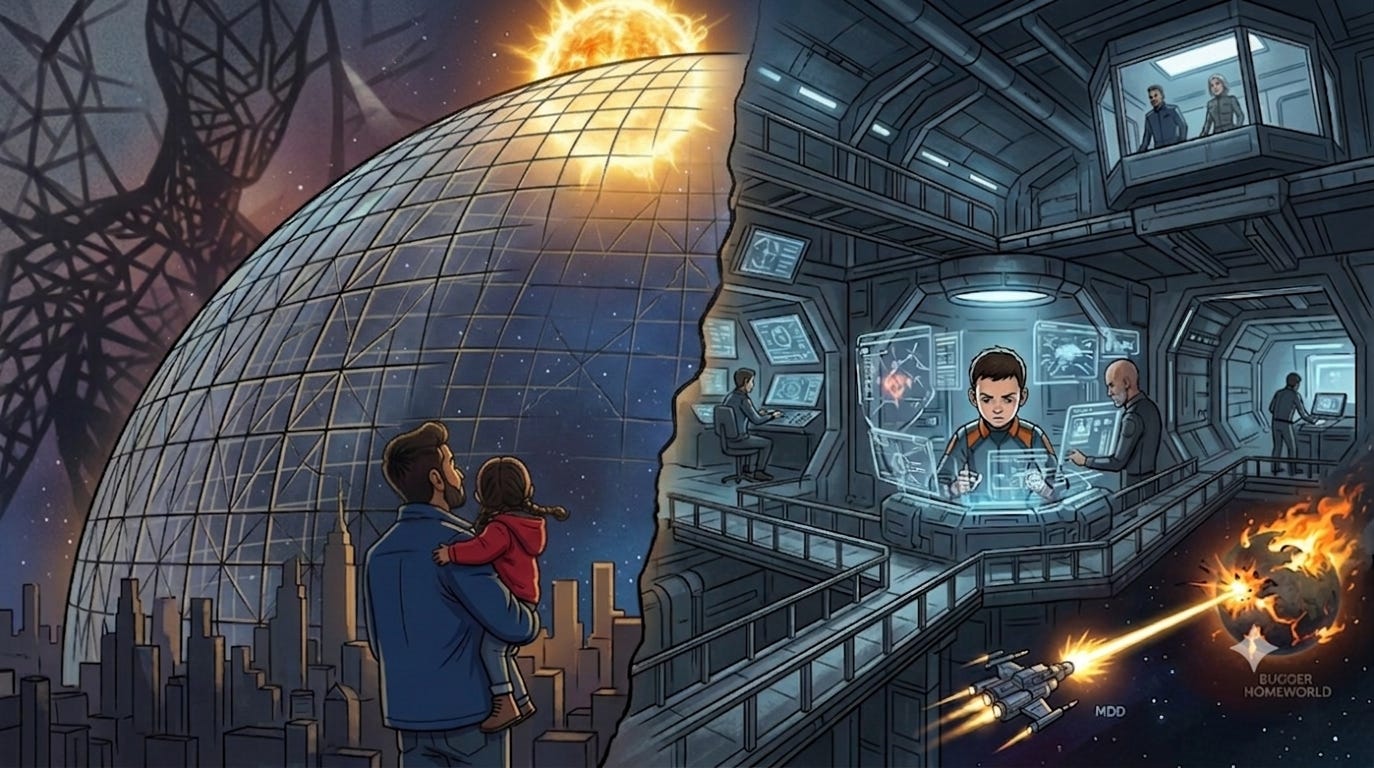
There's a moment in Sunstorm - the 2nd book of the Time Odyssey series by Arthur C. Clarke & Stephen Baxter - where Siobhan McGorran, the British Astronomer Royal, is sheltering with her child as a solar dome built over London by humanity's best minds begins to crack. She knows the dome and the solar shield built in space above Earth might not hold. She knows she didn't build it, didn't design it, and sure as hell didn't choose the threat looming over them and the rest of humanity.
And yet she has to decide whether to stay in her flat or venture forth out into the unknown. A choice between one uncertain outcome vs another.
There is no right answer. There is only an answer. And she has to live with the consequences of her decision.
That burden of impossible choice isn’t unique to Clarke & Baxter. I was reminded of it recently while re-reading Orson Scott Card’s Ender’s Game, before finishing off the rest of the Time Odyssey series. At first glance, they're very different works. Clarke & Baxter’s space opera is a meditation on deep time while Card’s work is a dark, classic bildungsroman (coming-of-age story).
But at their core, there is a throughline connecting them: helplessness in the face of all-consuming odds. The helplessness we feel when responsible for the lives of others, in a world we didn't design, facing threats we didn't choose.
And as the father of a toddler, that theme hit differently.
Manufactured vs Existential Helplessness
In Ender's Game, the titular character Ender Wiggin is deliberately isolated by his teachers in order to bring out his full potential (so they say). The adults around him - Graff, Anderson, the entire International Fleet - could help but explicitly choose not to do so. Ender’s lesson - no help is coming. Every battle, every crisis, every escalation, he faces alone. The final choice is made without full information, without consent, without understanding the true stakes.
It is manufactured helplessness. Betrayal disguised as necessity.
The characters in the Time Odyssey series face something different. The big bad, known as the Firstborn, aren't cruel. They are an intelligence so old, so beyond humanity that they transcend cruelty. They are cosmic forces, like gravity or entropy, and as unknowable to us as dark matter & dark energy. There's no betrayal because there was never an expectation of care or compassion. Humanity survives in the third book only because the Firstborn allow it, not because we somehow won.
That's existential helplessness. It says that the universe is indifferent not malicious.
I'm learning that parenthood is equally both at once.
A Parent's Burden & the Cost of Action
You don't choose the trials and tribulations that your child will face. Societal, accidental, medical, political, injustice - these aren't your fault but they are your problem. You can't protect them from everything. You can't control all the outcomes. You can't guarantee happily ever after.
And yet - you act. You choose. You stand between your offspring and the storm, knowing the tempest is bigger than you are.
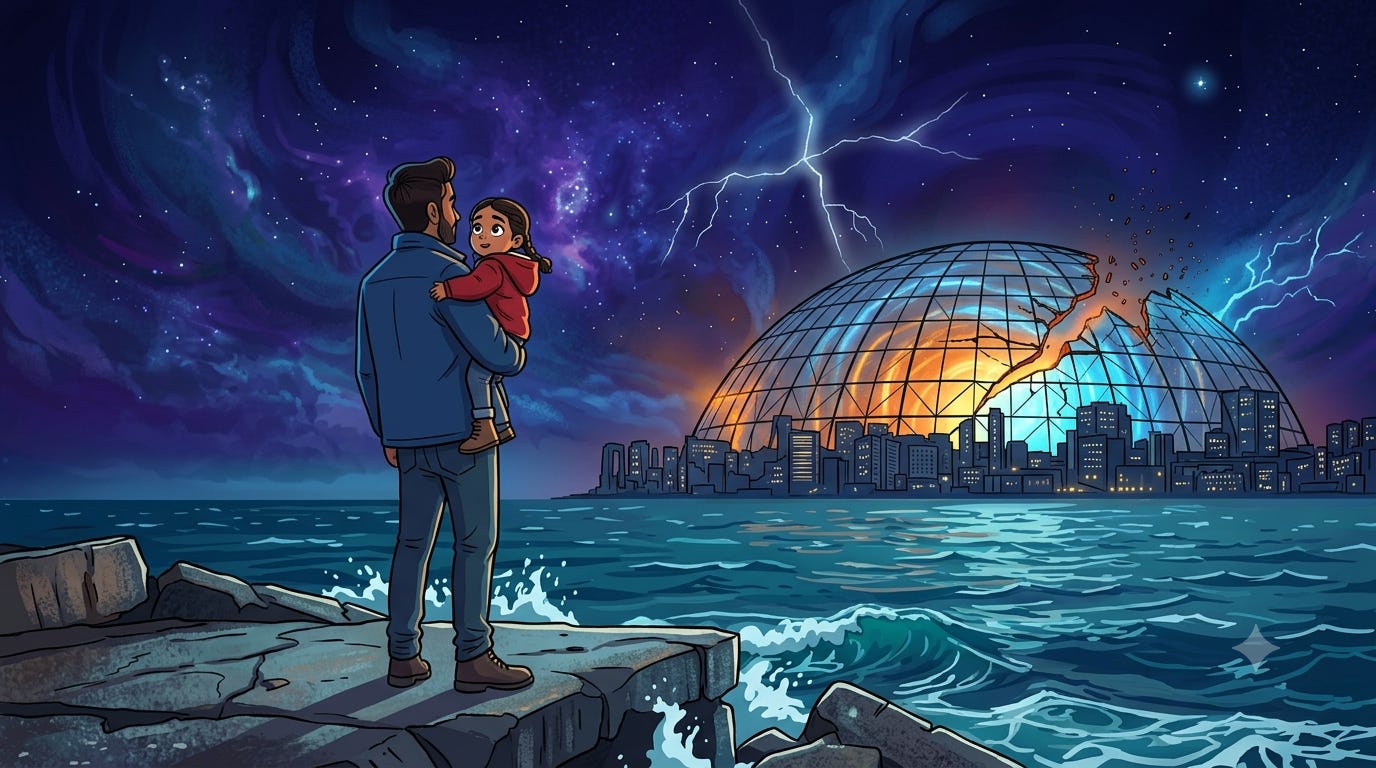
The Astronomer Royal leaves the shelter when the dome cracks. Ender wholly destroys the Buggers to ensure they will never ever have a chance to come back. Both are saying the same thing - I will do what I must with that I have, and I will bear the brunt of the consequences of my actions.
Both works understand that this kind of action costs. And that cost is unrecoverable. Ender carries genocide for the rest of his life. He “wins" but is broken by it. The Time Odyssey characters survive but they're marked by what they've endured. McGorran doesn't get a parade - she gets a child who's still alive, for now.
There’s no triumph in any of these moments. No victory music. Just a human doing what humans have always done - making the call imperfectly, living with the consequences, hoping it was enough.
The Quiet Heroism
The power in our house has gone out more times in the past three years than I’ve experienced in the previous 30+ years I’ve lived in Pittsburgh. It’s a really helpless feeling. But you do the best you can… flashlights, candles, weighing whether to buy an emergency countertop gas stove or spring for a big emergency generator. It’s scary but the bucks stops with me. You decide and then move on… and thankfully, the lights eventually come back on.
I think about this when my daughter comes running to me because I turned my head for a minute and she has run into a wall or a pole. I can’t protect her from everything. I can’t stop the world from being the world. I can’t freeze time. I can’t build a world that won’t crack. I can’t bubble wrap everything.
This isn't what most of us think of as heroism. I'm a father; that's my job. It's certainly not what we're sold in most stories. No grand prophecies fulfilled. No orchestral music swelling as the hero saves the day.
Action is the quiet heroism of parenthood. Of citizenship. Of being human in a universe that doesn’t owe our species anything.
Clarke & Baxter created something that says - Yes, you are insignificant on a cosmic scale. Yes, forces beyond your ken will shape your fate. And yes, it still matters how you respond.
Card says something similar, but perhaps more pointedly - You will be alone with the choice. You will not have all the information. You will bear the consequences even though you didn't ask for them. And you still must act anyway.
We act not because we are guaranteed to win. We act because not acting would mean surrendering something primal, something essential about ourselves.
The Honest Victory
The real lesson from these books is not that we're simply helpless - we are, in many ways that matter. It is that helplessness doesn't absolve us of responsibility.
The Astronomer Royal chooses. Ender chooses. We choose.
Every day, in myriad ways, we stand betwixt our loved ones and the storm. We build what shelters we can. We make the best call we can with the information available.
The storm is bigger than us. The universe is indifferent. The shield might crack.
We show up anyway.
That's not happily ever after. But it is honest. And in a world that didn't promise perfect outcomes, honesty is perhaps the only victory we can get.
Love this post! There’s a lot of parallels in the climate activism movement and in civil rights. You act even when you will not survive to see the benefits if any. You act bc it’s the right thing to do, even if it’s 7 generations into the future.
There’s a quote I love for its heartbreaking truth: "Not all battles are fought for victory - the point of some battles is to remember that someone was on the battlefield." - Ravish Kumar