
Think of it as the ultimate “leader’s tax”. We love a good “Chosen One” story but we usually stop the tape before the bill finally comes due. (And as Mordo once said, “the bill comes due always”). We call the Chosen few heroes, but by the end, they sometimes develop into something more visceral, even degraded: Sin-Eaters. These are the figures who consume the moral debt of their people - committing the atrocities required for survival - so that the rest of the tribe can live in a world they are still "pure" enough to enjoy.
We rarely talk about what happens next to these people who didn’t just save the world, but had to burn themselves to the ground to do it. When the war is won and the dust settles, what happens to the person who was forced to become a weapon?
I recently finished Tasha Suri’s The Burning Kingdoms trilogy. The denouement of the 3rd book, The Lotus Empire, reminded me a lot of the closing sequences of The CW show The 100. (No, really, it’s not that tortured and it is that deep). There is a shared, brutal truth in these works. The real reward for some leaders isn’t a crown or a seat at the table. It is the return of their humanity, earned through a very specific, often solitary, kind of isolation. It is the transition from being a symbol for the masses to being a private, anonymous citizen.
SPOILER ALERT for both The CW’s The 100 and Tasha Suri’s The Burning Kingdoms trilogy
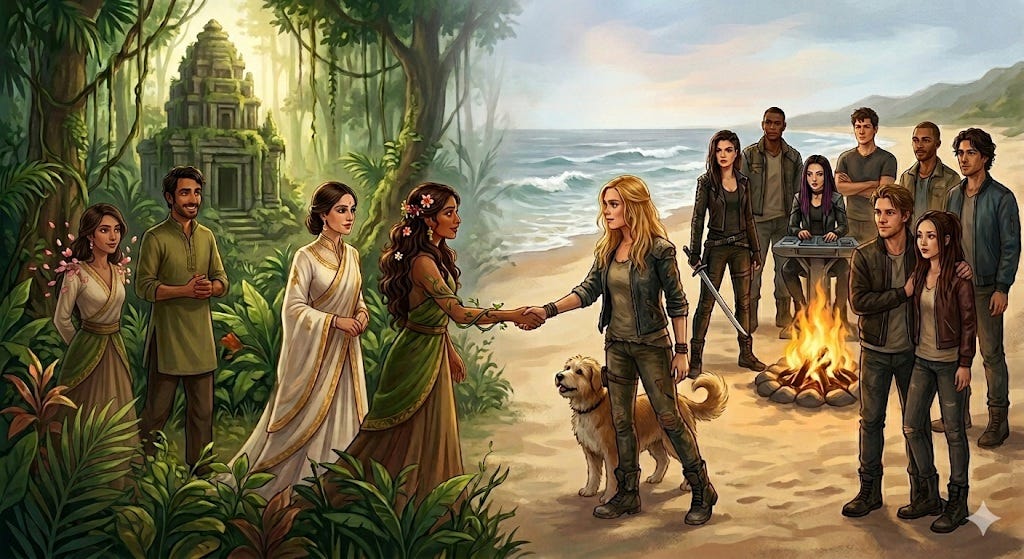
The Sin-Eater’s Fate
In the final moments of The 100, Clarke Griffin stands in a throne room on the planet of Bardo facing a metaphysical trial for the fate of the entire human race. Clarke’s journey in The 100 has always been defined by the impossible choice. By the series finale, she has become the ultimate Sin-Eater. In the middle of the trial, she executes the villain, Bill Cadogan. To the judge, it looks like simple vengeance - the same old human lust of blood for blood.
But for Clarke, it is her final, most ruthless calculation. She knows that Cadogan - a man who spent centuries stripping his people of their emotions and freezing them in cryo-sleep - will fail the test. By killing him, she stops a disaster in progress. It is then through the parallel efforts of others that the species is finally allowed to "transcend."
It proves to be a devastatingly lonely victory for Clarke. The rest of humanity transcends into a hive-mind of eternal light; an existence without pain or death. Clarke is left behind. She is sent back to a regenerated but completely empty Earth.
Clarke is barred from paradise because she took on the moral stains required to hold the gate open for everyone else. Her journey across an empty planet - walking through the skeletal remains of the original drop ship and the silent forests she once bled to protect - is the ultimate penance.

The Burden of the Crown: Malini
By the end of The Lotus Empire, Empress Malini has been “burned away” by her own ambition and the ruthlessness required to win. She has spent the entire trilogy consuming the “rot” of her family line and the violence of her throne.
Malini wins the war and wears the crown, but the real resolution is her eventual departure. She realizes that the golden palace is just another cage. She leaves the throne behind and travels to a quiet part of Ahiranya. There she finds her great love Priya by a secluded lake. Priya has survived as a semi-divine guardian of the land, a “Yaksa-born” entity whose life is tethered to the magic of the earth itself.
It is Malini’s final act of abdication - choosing to be a person in a quiet corner of the world rather than an icon, lauded but not loved - that is her reward.
Journey to the West
Likewise, Prince Rao chooses to reject the machinery of the state and to walk away into the unmapped West with Sima, his most trusted commander and equal. This isn’t a retreat of cowardice; it is a purposeful abandonment of ‘legacy’ in favor of just being a man. Rao realizes that as long as he stays within the empire’s borders, he will always be a Prince, a symbol for others to use. By choosing the fringe, he chooses his own soul. However, Rao’s choice is made possible largely because Malini was willing to be the monster of the story.

The Women Who Burned the World
The burden of the Sin-Eater is the throughline between Clarke Griffin and Empress Malini. They are the women who made the choices no one else would, staining their souls to ensure their people’s survival. Clarke is the Wanheda (Commander of Death) in a world that has transcended death; Malini is a ruler of fire in a kingdom that needs peace. They are defined by the fire they wielded, and it leaves them scarred and separate from the very people they saved. Their tragedy is that they were so good at surviving the war that they nearly forgot how to live in the peace they created.
The Human Anchor
This is where the concept of an “anchor” becomes the only thing that saves these characters from total dissolution. Without a human anchor, these leaders would just drift into the divine or the monstrous. For Malini and Priya, their connection at that quiet lake is the mortal space where they are allowed to be just themselves, away from the spirits and the crown. Their love isn't just a romance; it is a refuge from the weight of their crowns and the expectations of their subjects. Priya is the home Malini finally allows herself to have.

For Clarke, the anchor arrives in the final scene on a beach. Just as she is about to accept that she will live out her days in solitude, she finds that her core friends - the very people for whom she fought - voluntarily descended from paradise. They gave up immortality to grow old and die with her. Their return is the ultimate “thank you” for her sacrifice. They are telling her that they know she had to stay behind so they could go forward but they would rather be in the wreckage with her than in heaven without her. They choose dirt and mortality over the light, just to keep her from being alone.
The Anatomy of a Bittersweet Reward
We call this a reward because for a hero who has been a weapon for too long, the greatest gift isn’t “happily ever after” - it is the right to stop fighting. It is the transition from being a savior to being… normal (sortuv).
By keeping their memories and their finite lives, these characters attempt to reclaim the humanity they sacrificed to win their respective wars. They choose the messy, painful, beautiful reality of mortal life. In the end, the individual conflicts between their pasts and futures are a tie. They are all free. They still carry the weight of the past, but they carry it in the company of the only people who truly know who they are. They aren’t the ones who burn the world anymore; they are finally allowed to live in it.