
I’m coming towards the end of Robert Jordan’s The Wheel of Time series. It’s fascinating to me how the grand scale of the world that Jordan built informs how his characters navigate the messiness, the fallibility of being human.
The Wheel of Time is a sprawling epic. I’ve read 13/14 in the series. Jordan built a series with an intricate magic system, many many named characters, and distinct cultures stretching across a continent. We could spend hours and hundreds of pages discussing the intricacies of this world. But that’s not the important part, fun though it is. It seems that the grander the scale, the more we feel the messiness and fragility of Jordan’s characters’ humanity. He uses this massive world-building project to shine a light on their fragility, time after time.
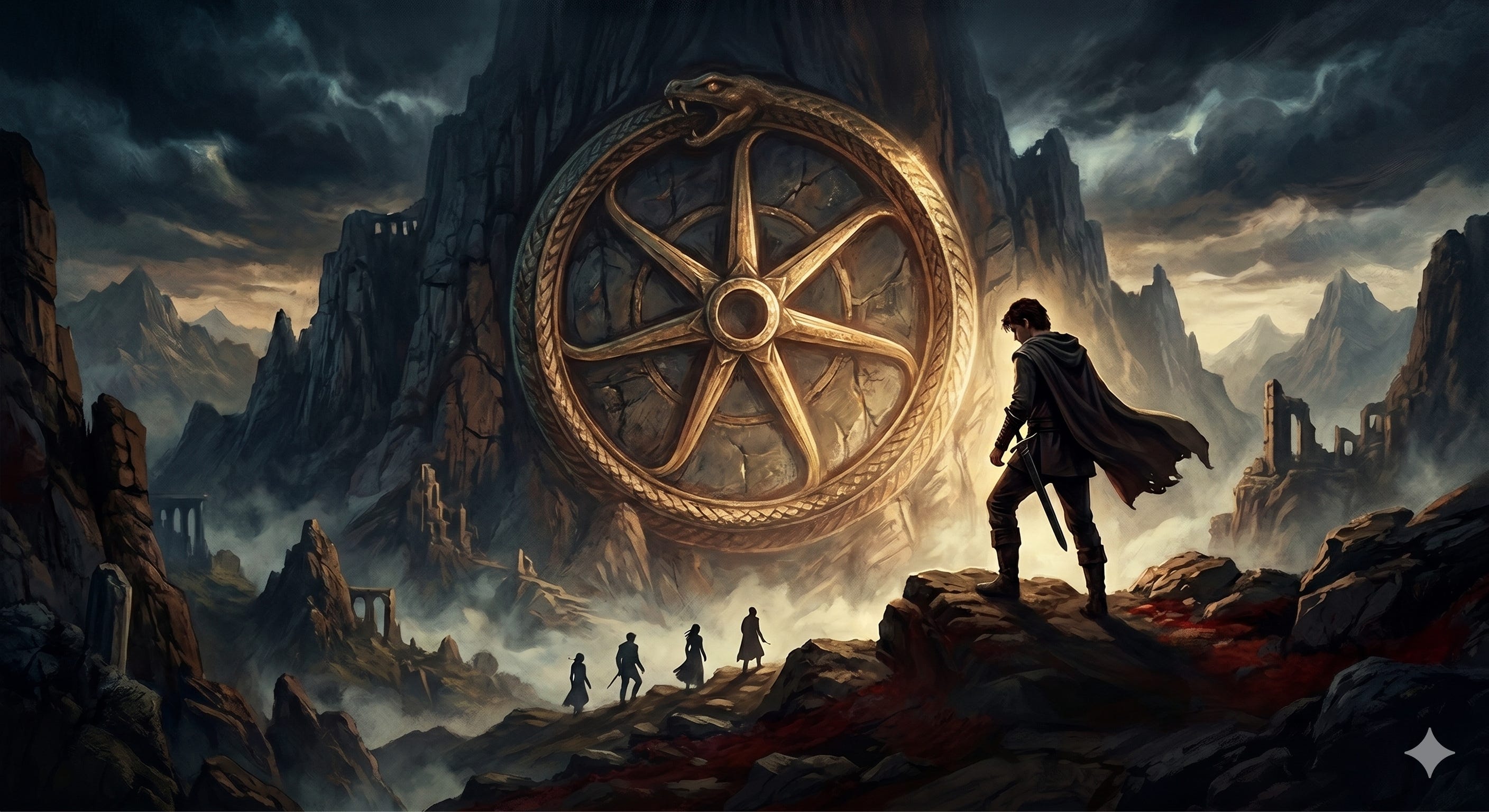
The Wheel. It turns and turns, spitting people out into a pre-established pattern of its own need. The most important characters in the Pattern, the Ta’veren, are those rare individuals around whom the Wheel forcefully weaves the fates and circumstances of all surrounding lives. But even though they know they are Ta’veren, the characters don’t march proudly towards their fated destiny. They are dragged kicking and screaming towards the Final Battle called Tarmon Ga’idon.
Kicking and Screaming Toward Destiny
For the Dragon Reborn, Rand al’Thor, the idea of being controlled by anyone or anything is enough to send him into severe mental isolation, paranoia, and emotional numbness.
Mat Cauthon resists the responsibility that the Pattern thrusts on him, trying to maintain the facade of a carefree rogue. He struggles between his desire for absolute personal freedom and his (unfortunately) real and inescapable sense of duty. The reluctant hero, so to speak. (My favorite character in the series).
Perrin Aybara moves agonizingly slowly towards his destiny, convinced that he is naught but a simple blacksmith. He resists his Wolf nature throughout the series, almost until the very end.
Nynaeve al’Meara has to fight against her own self-righteousness and her explosive temper. She hates showing any vulnerability and cannot see past her pre-judgments of people even her increasingly powerful friends from the Two Rivers.
Egwene al’Vere’s seeming ruthlessness and drive to ascend the ranks of the Aes Sedai are both strength and weakness. She demands transparency while quite easily employing deceptive and emotionally manipulative means to bend all whom she encounters to her will.
This is but a taste of the destructive tendencies that Jordan’s characters unleash upon themselves. Even ‘minor’ characters such as al’Lan Mandragoran, Faile Bashere, Min Farshaw, Elayne Trakand and Aviendha are given multiple turns to fight against the better angels of their natures. The entire series is an exercise in bringing these characters around to the precise point where they can fight the Last Battle.
The Power of Choice in a Fated World
Ultimately, The Wheel of Time argues that heroism is not defined by grand power or fulfilling prophecies. It shows that true heroism is found in the messy, painful choices of people who show up. Period. As Rand’s father Tam says in The Gathering Storm:
“You may not have a choice about which duties are given you. But you can choose why you fulfill them.”
Jordan built a world governed by vast, sweeping laws, only to show that the most unpredictable, untamable force in creation is simply the human heart.